
Table of Contents
- Why Carpal Tunnel Injuries Happen at Work in California
- Understanding Your Workers Compensation Rights for Carpal Tunnel
- How We Evaluate Your Carpal Tunnel Claim Value
- Medical Evidence and Causation in Carpal Tunnel Cases
- Navigating Permanent Disability Benefits for Carpal Tunnel
- Why Many Claims Get Denied and How We Fight Back
- Our Process: From Consultation to Compensation
- Psychological and Cumulative Trauma Protection in Your Case
- Construction and Repetitive Work Injury Representation
- Your Free Consultation: No Recovery, No Fee Guarantee
- Frequently Asked Questions (FAQ)
Why Carpal Tunnel Injuries Happen at Work in California
Carpal tunnel syndrome ranks among the most common workplace injuries we handle at California Work Injury Law Center. Whether you work in data entry, manufacturing, construction, or any role requiring repetitive hand and wrist motion, you’re at risk. The problem isn’t always obvious either. Many employees don’t realize their symptoms qualify for workers compensation until pain becomes severe enough to affect their livelihood.
This guide walks you through your rights, claim evaluation, and the steps we take to secure the compensation you deserve.
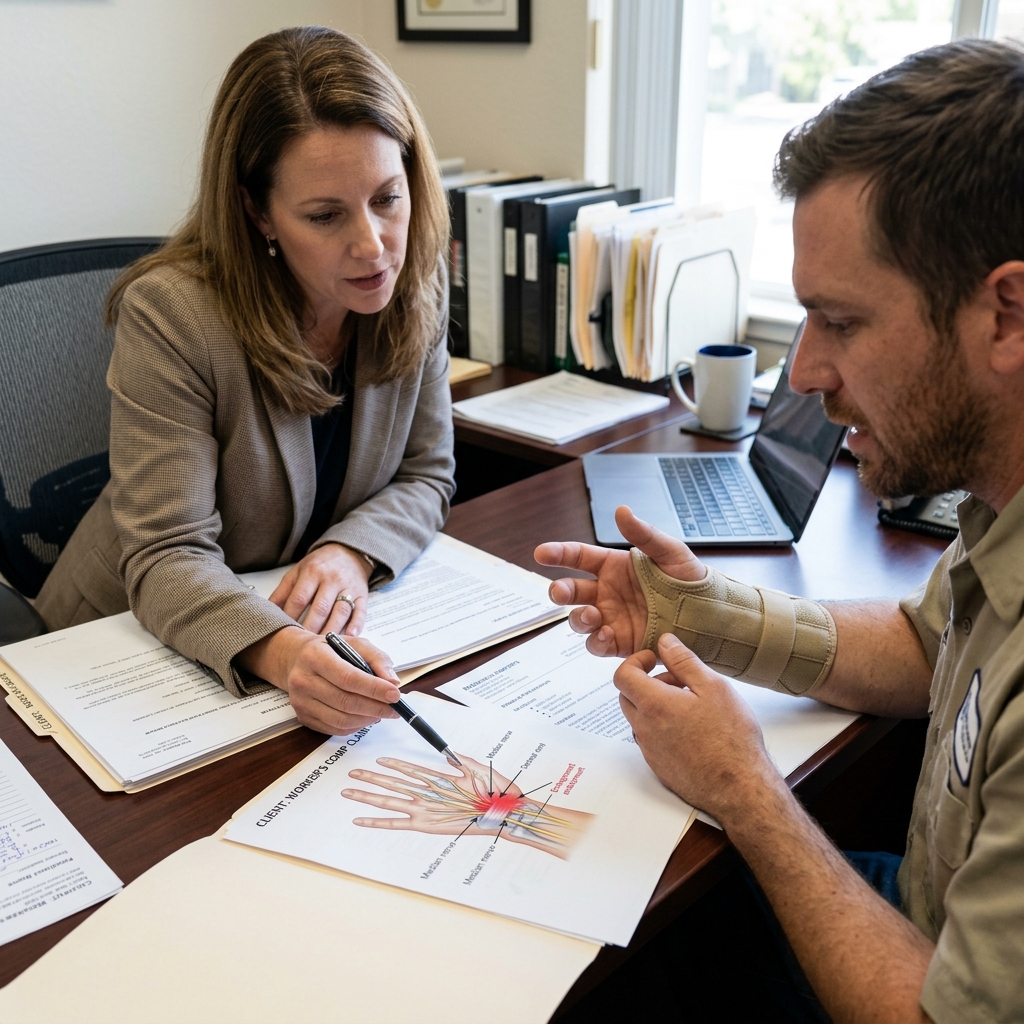
Carpal tunnel syndrome develops when the median nerve that runs through your wrist becomes compressed. The nerve passes through a narrow tunnel of bone and ligament at the base of your palm. When you perform repetitive gripping, bending, or twisting motions day after day, the tendons swell and pressure builds. Over time, this compression causes numbness, tingling, weakness, and pain.
The industries most affected include:
- Assembly and manufacturing (repetitive gripping and fastening)
- Data entry and office work (continuous keyboard and mouse use)
- Construction trades (hammering, sawing, tool operation)
- Meatpacking and food processing (cutting and handling)
- Healthcare (patient handling and repetitive tasks)
What makes carpal tunnel a workers compensation issue in California is that your work conditions directly caused or significantly aggravated the condition. Unlike a one-time injury, carpal tunnel develops through cumulative exposure to ergonomic hazards. California law recognizes this, and your employer’s insurance must cover medical treatment and disability benefits if we prove work causation.
Understanding Your Workers Compensation Rights for Carpal Tunnel
Under California law, you have the right to file a workers compensation claim for any injury that arises out of and occurs in the course of employment. Carpal tunnel qualifies because it results from job duties. You don’t need to prove negligence or fault. The system is “no-fault,” meaning you receive benefits regardless of whether your employer violated safety rules.
Your rights include:
- All necessary medical treatment related to carpal tunnel (doctor visits, imaging, surgery, therapy)
- Temporary disability benefits if you cannot work during treatment
- Permanent disability benefits if the condition leaves you with lasting limitations
- Vocational rehabilitation if retraining is necessary
- Medical legal fees and mileage reimbursement
One critical point: California recognizes both cumulative trauma claims and specific traumatic injury claims for carpal tunnel. A cumulative trauma claim addresses gradual nerve damage from months or years of repetitive work. This distinction matters because the statute of limitations and claim procedures differ between the two.
How We Evaluate Your Carpal Tunnel Claim Value
Your claim value depends on several medical and legal factors. We analyze each element to maximize your settlement or litigation award.
Severity of permanent impairment. We use the American Medical Association Guides to Permanent Impairment and California’s Permanent Disability Rating Schedule to assign a percentage rating. A rating reflects how much carpal tunnel has reduced your earning capacity. Ratings typically range from 5% to 40% depending on symptoms, test results, and functional limitations.

Medical expenses. We calculate all past and future treatment costs, including surgery if needed, physical therapy, and ongoing care.
Age and work history. Younger workers generally receive higher awards because they have more working years ahead with a permanent disability. We also consider your wages, job skills, and retraining potential.
Specific job demands. Someone returning to construction work with carpal tunnel faces greater challenges than someone in a less physically demanding role. We factor in whether your current job remains sustainable.
Strength of medical evidence. Objective test results like nerve conduction studies and imaging carry more weight than subjective complaints alone. We work with your doctors to build the strongest clinical record.
A typical carpal tunnel claim in California might settle between $15,000 and $75,000, though complex cases or those heading to litigation can exceed these ranges significantly. We provide a detailed valuation during your consultation after reviewing medical records and understanding your specific circumstances.
Medical Evidence and Causation in Carpal Tunnel Cases
Insurance companies challenge carpal tunnel claims regularly because symptoms can seem subjective. We build causation through objective medical evidence.
The strongest evidence includes:
- Electrodiagnostic testing (nerve conduction studies and electromyography showing nerve compression)
- MRI or ultrasound imaging confirming swelling or nerve narrowing at the wrist
- Physician documentation linking your job duties to nerve compression
- Job history showing years of repetitive wrist motion
- Pre-employment baseline testing (if available) showing you had normal function before the job
Many employees ask whether non-work activities like hobbies or sports can undermine their claim. The answer is nuanced. Pre-existing conditions or off-the-job activities don’t eliminate your right to benefits if work was a substantial contributing factor. What matters is proving work was a significant cause.
For detailed guidance on building medical records for repetitive strain injuries, read our complete guide on medical evidence for RSI.
We also recommend independent medical examination by a workers compensation specialist if the insurance company’s doctor disputes causation. An IME can provide the objective evidence needed to overcome disputes.
Navigating Permanent Disability Benefits for Carpal Tunnel
If carpal tunnel leaves you with permanent limitations, you’re entitled to a lump-sum permanent disability award. This payment compensates for reduced earning capacity for the rest of your life.
The calculation follows a formula under California law. Your rating percentage, age, and occupation determine the award amount. A worker rated 20% permanent disability at age 40 in a skilled trade receives significantly more than the same rating at age 60.
You also have the right to vocational rehabilitation if you cannot return to your pre-injury job. Rehabilitation services might include:
- Job counseling and assessment
- Retraining in a new field suited to your physical limitations
- Job search assistance
- Wage loss replacement during retraining
Some employees prefer a larger lump-sum payment instead of rehabilitation. We help you weigh both options based on your age, skills, and long-term goals.
Why Many Claims Get Denied and How We Fight Back
Insurance companies deny carpal tunnel claims more often than you might expect. Common reasons include:
Weak medical causation. The insurance company argues your symptoms stem from off-the-job activities rather than work. Without solid diagnostic testing and physician statements linking work to nerve compression, denial is likely.
Incomplete claim filing. Missing medical records, incomplete job descriptions, or delayed reporting can trigger denial. California law allows claims to be filed late in some circumstances, but early reporting strengthens your case.
Pre-existing condition arguments. The insurer claims you had carpal tunnel before employment and work merely aggravated it. This doesn’t eliminate your benefits, but it requires careful medical proof of when symptoms truly began and how work made them worse.
Medical opinion disagreement. The insurance doctor’s opinion contradicts your treating physician’s assessment. We resolve this through IME, legal argument, and sometimes by requesting a supplemental rating.
When a claim is denied, you have the right to appeal. The appeals process in California involves requesting reconsideration, filing a Petition to Reopen, or pursuing litigation. We handle all appeal stages and represent you at hearings before the Workers Compensation Appeals Board.
Our Process: From Consultation to Compensation
We guide you through a straightforward process designed to minimize stress while maximizing your recovery.
Step one: Free consultation. You meet with one of our attorneys (at no cost) to discuss your injury, work history, and symptoms. We review what you’ve already reported to workers compensation and identify missing elements.
Step two: Investigation and medical records. We obtain your complete medical file, employment records, and job documentation. Our team investigates your specific work duties and exposure to repetitive motion.
Step three: Medical evaluation. If needed, we arrange examination by a specialist who can provide strong diagnostic evidence and opinion regarding work causation.
Step four: Demand or litigation. We either negotiate a settlement with the insurance company or file a case at the Workers Compensation Appeals Board. Either way, we present the strongest possible case supported by medical evidence and California law.
Step five: Resolution. Once settled or litigated, we ensure you receive all entitled benefits and handle any remaining medical or rehabilitation coordination.
Throughout this process, you pay nothing upfront. We work on a contingency basis.
Psychological and Cumulative Trauma Protection in Your Case
Carpal tunnel often accompanies psychological stress from chronic pain, fear of job loss, or anxiety about disability. California law recognizes that workplace injury can trigger psychiatric conditions, and you’re entitled to benefits for these as well.
If you’ve developed depression, anxiety, or sleep disorders as a direct result of carpal tunnel syndrome, we pursue compensation for psychiatric treatment alongside your physical injury claim.

Additionally, learn more about California's cumulative trauma framework, which is particularly relevant to carpal tunnel. Cumulative trauma claims are filed once you’ve stopped exposure to the hazard or once symptoms become severe. We help you determine whether filing a cumulative trauma claim makes strategic sense in your situation.
Construction and Repetitive Work Injury Representation
Construction workers face elevated carpal tunnel risk due to tool vibration, repetitive gripping, and sustained awkward wrist positions. We’ve successfully represented countless construction trades workers including framers, electricians, plumbers, and heavy equipment operators.
Construction sites present unique challenges for causation arguments. Multiple contractors, equipment changes, and varied job duties across projects can cloud the causation picture. We build detailed work histories documenting specific tools, job tasks, and duration of exposure throughout your employment.
We also work closely with construction unions and are familiar with prevailing wage calculations and how permanent disability affects wage-replacement benefits in union trades.
Your Free Consultation: No Recovery, No Fee Guarantee
If you’re experiencing carpal tunnel symptoms or have been denied a workers compensation claim, we’re ready to help. We offer a completely free legal consultation with no obligation.
During your consultation, we’ll review your medical records, discuss your work history, answer your questions about California workers compensation law, and explain exactly how we can assist you.
Here’s our promise: We work on a contingency fee basis. That means you pay nothing unless and until we recover compensation for you. There are no upfront costs, no hidden fees, and no surprises. If we don’t recover, you don’t pay.
Contact California Work Injury Law Center today to schedule your free consultation. We have multiple office locations across California and can often arrange consultations by phone or video if travel is difficult. Let’s get started on securing the compensation and treatment you deserve.
Schedule a Free Consultation Phone Number: 657 605 4418
Frequently Asked Questions (FAQ)
What qualifies as a compensable carpal tunnel injury under California workers compensation law?
We handle carpal tunnel claims that develop from workplace activities, including repetitive motions, prolonged typing, gripping, or other occupational tasks that strain the median nerve. California law recognizes both acute injuries and cumulative trauma conditions, so your carpal tunnel doesn’t need to result from a single incident to be compensable. We evaluate whether your job duties directly caused or substantially aggravated your condition, which is the key factor in establishing your claim’s validity.
How do we determine the value of your carpal tunnel workers compensation claim?
We assess your claim’s value by examining your medical evidence, wage loss, temporary disability payments, and anticipated permanent disability rating. Our team reviews your medical records, diagnostic test results, and treatment history to establish clear causation between your work duties and carpal tunnel syndrome. We also factor in your earning capacity, the likelihood of requiring ongoing treatment or surgery, and your permanent functional limitations to ensure you receive appropriate compensation for both current and future impacts.
Why do carpal tunnel claims get denied, and how do we respond?
We see denials occur when insurers dispute whether your carpal tunnel arose from work activities or claim insufficient medical evidence connecting your condition to your job duties. We combat these denials by gathering comprehensive medical documentation, expert opinions, and detailed work history analysis to prove causation. Our litigation experience allows us to challenge insurer decisions through appeals and hearings when necessary to secure the benefits you deserve.