
Table of Contents
- 1. Understanding Your Rights After an Industrial Accident
- 2. Identifying When You Need Specialized Legal Representation
- 3. Evaluating Industrial Accident Attorneys and Their Track Records
- 4. Securing Evidence and Documentation for Your Claim
- 5. Navigating Temporary and Permanent Disability Benefit Claims
- 6. Addressing Cumulative Trauma and Psychological Injury Cases
- 7. Why Our No Recovery, No Fee Model Protects Your Interests
- Frequently Asked Questions (FAQ)
1. Understanding Your Rights After an Industrial Accident
Industrial accidents happen in seconds, but their consequences reshape lives over years. If you’ve suffered a workplace injury in California, you’re navigating a complex system where timing, documentation, and expert guidance determine whether you receive fair compensation or settle for less than you deserve.
We’ve represented thousands of injured California workers through workers’ compensation claims, permanent disability disputes, and construction site accidents. This article shares the core strategies we use to help our clients secure the maximum benefits they’re entitled to under California law.
California workers’ compensation law guarantees certain protections to nearly every employee injured on the job, regardless of fault. You have the right to:
- Medical treatment for your injury at no cost to you
- Temporary disability benefits while you’re unable to work
- Permanent disability benefits if your injury causes lasting impairment
- Return-to-work protections and job retraining assistance
- Death benefits paid to your family if the injury proves fatal
The misconception most injured workers hold is believing they need to prove their employer was negligent. California’s workers’ compensation system is “no-fault,” meaning you can recover benefits even if the accident was partially your fault or happened due to unsafe workplace conditions your employer didn’t create.
However, these rights only materialize if you file a claim properly and follow strict procedural requirements. Missing a deadline or filing incomplete paperwork can eliminate benefits you’ve already earned. The initial 30 days after your injury are critical: report the incident to your employer, document everything, and seek medical attention immediately. Your next action should be consulting with an attorney to ensure your claim protects your future earnings and medical care.
2. Identifying When You Need Specialized Legal Representation
Not every minor workplace injury requires an attorney. A simple strain that resolves in weeks and results in minimal lost time may settle quickly through your employer’s insurance carrier. But the moment your injury involves any of these factors, specialized legal representation becomes essential:
- Disputed injury claims (the insurer denies the injury happened at work)
- Permanent disability or chronic conditions
- Construction site accidents with multiple potentially liable parties
- Psychological trauma or stress-related injuries
- Cumulative trauma claims spanning months or years of work
- Claims involving a third party outside your employer (equipment manufacturer, property owner, subcontractor)
- Situations where your employer retaliates against you for filing
We frequently encounter cases where injured workers initially handle claims alone, only to discover months later that the insurance company undervalued their permanent disability rating or denied necessary medical treatment. By that point, critical evidence has disappeared and statute of limitations deadlines loom.
An industrial injury lawyer with experience in occupational injury cases brings immediate credibility to your claim. Insurance adjusters adjust their settlement offers upward when they know you have representation. More importantly, we protect you from common negotiation traps and ensure your medical documentation fully captures the extent of your injury.

If you’re unsure whether your situation warrants representation, schedule a free consultation with our team. We’ll evaluate your claim honestly and advise whether legal assistance strengthens your position.
3. Evaluating Industrial Accident Attorneys and Their Track Records
Choosing the wrong workers’ compensation counsel costs you tens of thousands in lost benefits. Many attorneys in this space operate like volume factories, handling hundreds of claims with minimal individual attention. Others lack the specialized courtroom experience necessary when insurers dispute claims or permanent disability ratings.
When evaluating attorneys for industrial accident representation, ask directly about:
- Case outcomes: What percentage of their clients receive their full requested benefits? How do their average settlements compare to similar cases?
- Trial experience: How many cases have they taken to trial in the last three years? Workers’ compensation litigation requires specific courtroom skills.
- Specialization: Do they focus exclusively on workers’ compensation, or do they split attention across personal injury, family law, and other practice areas?
- Medical relationships: Do they work with independent medical examiners who can challenge the insurance company’s medical evidence?
- Caseload size: How many active cases does the attorney personally handle?
At California Work Injury Law Center, we specialize exclusively in workplace injury representation. Our team has resolved thousands of workers’ compensation cases, and we personally try cases before judges when settlements don’t reflect fair value. We maintain relationships with occupational medicine specialists, psychologists, and vocational rehabilitation experts who strengthen our clients’ claims with credible independent evidence.
Your attorney’s track record reveals whether they’re a true advocate or simply processing cases. Request specific case examples similar to yours and ask how they’d approach your particular situation.
4. Securing Evidence and Documentation for Your Claim
The strength of your workers’ compensation claim lives or dies on evidence quality. Insurance companies pay based on documented medical findings, not your testimony alone about pain and suffering.
Start gathering evidence immediately after your injury:
- Medical records: Obtain copies of every medical report, test result, prescription, and treatment note. Request imaging studies (X-rays, MRI scans) from your healthcare provider. These create the clinical foundation for your disability rating.
- Incident details: Write down exactly what happened, the time, weather conditions, witnesses present, and what you were doing when injured. If your employer completed an incident report, request a copy immediately.
- Witness statements: Collect contact information and written statements from coworkers who saw the accident or understand your job duties.
- Photographic evidence: Document the accident scene, hazardous conditions, or equipment involved if possible. Photos taken days later still provide valuable context.
- Job description and work history: Gather documentation of your actual job duties, hours worked, and compensation history from the past 12 months.
- Communications: Keep all emails, text messages, or written communications with your employer or insurance company related to your injury or claim status.
We’ve seen countless claims weakened because workers relied on memory rather than contemporaneous documentation. Your brain’s recollection of pain levels from six months ago carries no weight with an insurance adjuster. Medical records created at the time of treatment become evidence; later statements become hearsay.
If you’ve already delayed evidence collection, don’t assume your case is damaged. We can often obtain missing documentation through legal discovery processes, but it requires additional time and effort. Start your evidence file today, regardless of whether you’ve retained counsel yet.
5. Navigating Temporary and Permanent Disability Benefit Claims

California provides two distinct disability benefits: temporary and permanent. Understanding the difference protects you from undershooting your actual compensation.
Temporary disability benefits replace lost wages while you’re recovering from your injury and unable to work. These continue until your treating physician determines you’ve reached maximum medical improvement (MMI), meaning your condition has stabilized and further treatment won’t materially improve function. At that point, temporary benefits end.
Permanent disability benefits compensate you for lasting impairment even after recovery. If your injury causes permanent reduced earning capacity, loss of function, or chronic pain, you’re entitled to a lump-sum permanent disability award calculated under California’s Permanent Disability Rating Schedule. A worker who loses a finger, for example, receives a specific disability rating that translates to a dollar amount regardless of their actual wages.
Here’s where disputes intensify: the treating physician’s “permanent and stationary” report determines when temporary benefits end and what permanent rating applies. Insurance companies frequently request independent medical examinations to challenge the treating doctor’s findings and argue for lower disability ratings.
We challenge these independent exams by retaining our own occupational medicine specialists who conduct counter-examinations. Two competent physicians can reach different disability conclusions on identical medical facts. Your counsel’s role is ensuring the insurance company’s medical opinion doesn’t override your treating doctor’s judgment without a strong fight.
Calculate your expected benefits conservatively: temporary benefits are straightforward math (your weekly wage replacement rate multiplied by weeks unable to work), but permanent disability calculations vary substantially. Work with an experienced occupational injury lawyer to ensure your permanent rating matches the actual functional loss documented in your medical records.
6. Addressing Cumulative Trauma and Psychological Injury Cases
Some workers’ compensation claims don’t stem from single dramatic accidents. Instead, months or years of repetitive motion, heavy lifting, or prolonged stress gradually damage your body or mind. These cumulative trauma cases involve unique legal complexity because the injury date itself is ambiguous.
For physical cumulative trauma, California recognizes conditions like carpal tunnel syndrome, herniated discs, tendinitis, and hearing loss caused by repeated occupational exposure. For psychological injuries, workers can recover for job-related stress, anxiety, PTSD from workplace violence, or harassment.
The statutory requirement for psychological injury claims is particularly stringent: you must prove the work injury was a “substantial factor” in causing your condition and that your employer subjected you to unusual and intense stress compared to ordinary job stress. Ordinary job frustration or occasional conflict doesn’t qualify. Repeated harassment, threats, or demands to perform dangerous work without proper training do.
Our cumulative trauma guide details the specific evidence insurers scrutinize in these cases. Medical documentation must establish causation: a doctor’s conclusion that “work contributed to this condition” lacks the specificity insurers demand. Detailed causation reports from occupational specialists carry far more weight.
Cumulative trauma cases require earlier intervention than acute injuries. Statute of limitations issues in cumulative cases are complex, and the date you file your claim can affect which treatments and lost wages qualify for coverage. Consult with counsel as soon as you suspect work caused your condition, rather than waiting until the condition becomes severe.
7. Why Our No Recovery, No Fee Model Protects Your Interests
The financial barrier preventing many injured workers from securing legal representation is fear of attorney costs. If you’re already missing work due to injury, the prospect of paying $3,000-$5,000 upfront for representation feels impossible.
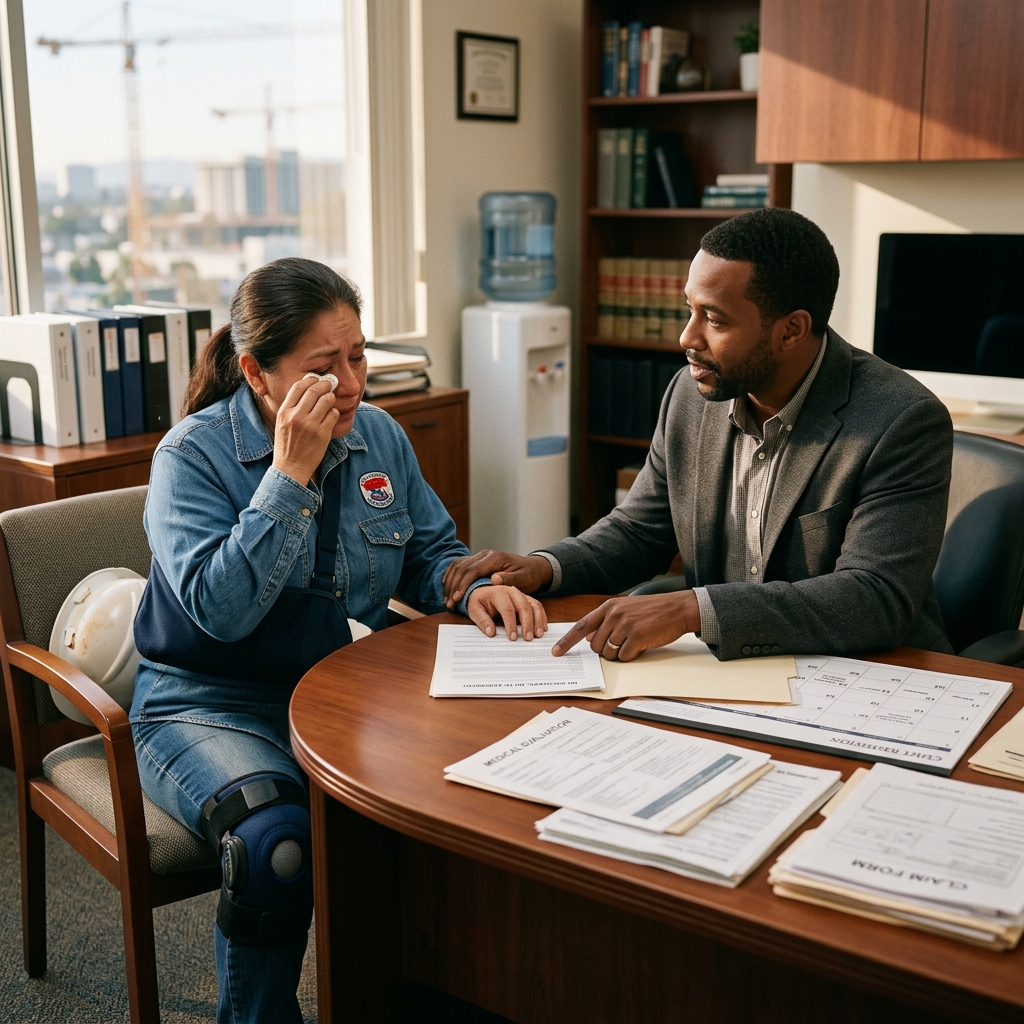
At California Work Injury Law Center, we operate on a contingency basis: we recover a fee only when we secure benefits for you. Our agreement is simple and transparent. We advance the costs of gathering evidence, obtaining medical records, and retaining expert witnesses. If we don’t recover benefits through settlement or trial, you owe us nothing.
This alignment of interests fundamentally changes how we approach your case. We don’t benefit from quick low settlements. We don’t process cases through volume. We profit when you profit, meaning our incentive is securing maximum compensation and fighting for every dollar you deserve.
Our contingency model also screens for meritorious claims. We decline cases where genuine liability problems exist or where the injury documentation is too weak to overcome insurance company skepticism. This selectivity means we dedicate resources only to cases where we’re confident we’ll deliver results.
Beyond the fee structure, our multiple office locations across California ensure you have local representation. You’re not a case number managed remotely by a large firm. Our team meets with you in person, understands your community’s labor conditions, and knows the local judges and defense counsel who’ll evaluate your claim.
If you’ve suffered a workplace injury in California, the path forward starts with honest evaluation of your rights and realistic assessment of your claim’s value. We provide free consultations specifically so you can understand whether representation strengthens your position without financial risk.
Contact us today for your complimentary case review. Let’s discuss your injury, explore the compensation you’re entitled to, and chart a strategy that protects your financial stability while you recover.
Schedule a Free Consultation Phone Number: 657 605 4418
Frequently Asked Questions (FAQ)
What should I do immediately after an industrial accident in California?
We recommend documenting everything at the scene: take photos of the accident location, equipment involved, and any visible injuries. Report the incident to your employer right away and seek medical attention, even if injuries seem minor. Keep copies of all medical records, incident reports, and witness statements, as we’ll need this evidence to build the strongest case for your compensation claim.
How does your no recovery, no fee model work?
We operate on a contingency basis, which means we only get paid if we recover compensation for you. There are no upfront costs, hourly fees, or out-of-pocket expenses for our legal services. You can pursue your claim with complete confidence knowing that our success depends entirely on securing the benefits and damages you deserve.
Do you handle psychological injuries and cumulative trauma claims?
Yes, we regularly represent workers with psychological injuries and cumulative trauma cases throughout California. These claims can be complex since they require medical evidence linking your mental health condition to workplace conditions or repeated incidents. Our team has extensive experience proving these injuries qualify for workers’ compensation benefits, including temporary and permanent disability awards.