
Table of Contents
- Understanding Cumulative Psychological Trauma in the Workplace
- Why Standard Claims Fail Without Expert Legal Representation
- How We Document and Build Your Psychological Injury Case
- Medical Evidence Our Team Leverages for Your Claim
- The Critical Role of Expert Witness Testimony
- Overcoming Insurance Company Denials and Appeals
- Our Proven Track Record with Psychological Trauma Claims
- The Timeline and Process for Your Case Resolution
- Why You Need Our Specialized Expertise for Your Claim
- Frequently Asked Questions (FAQ)
Understanding Cumulative Psychological Trauma in the Workplace
Psychological injuries from the workplace are among the most challenging claims to win in California’s workers’ compensation system. Unlike a broken arm or laceration, cumulative psychological trauma builds gradually, often without obvious triggering events. Insurers frequently dismiss these claims as non-work-related stress or pre-existing conditions. We’ve spent years developing the strategies and expertise needed to overcome this skepticism and secure the benefits our injured clients deserve.
Cumulative psychological trauma in California workers’ compensation refers to mental health injuries that develop through repeated workplace exposure rather than a single incident. An employee might experience ongoing harassment, discrimination, witnessing workplace violence, or sustained high-stress environments that collectively damage their mental health. Examples include nurses exposed to patient trauma, teachers facing persistent bullying from administrators, or construction supervisors managing impossible deadlines with inadequate resources.
California law recognizes psychological injuries as compensable when they arise from employment. However, the standard is higher than for physical injuries. We must prove that the psychological condition was caused by actual working conditions, not merely by the employee’s personal reaction to work. The Appeals Board distinguishes between employment-caused stress and ordinary workplace stress that any worker might experience.
The timing of cumulative trauma makes documentation critical. Unlike acute injuries with clear injury dates, cumulative claims require us to establish when the condition became disabling and trace it back to workplace factors. This retroactive connection is where many unrepresented workers stumble.
Why Standard Claims Fail Without Expert Legal Representation
We see the same patterns repeatedly in rejected claims. Injured workers file basic paperwork, rely solely on their treating physician’s opinion, and expect the insurance company to accept their account of events. This approach fails because insurers operate from a fundamentally different position. They have risk adjusters, defense lawyers, and decades of case law backing their denials.
Without strategic representation, several critical failures occur. First, workers often lack detailed documentation of workplace incidents. A conversation with a supervisor goes unrecorded; an email expressing distress disappears in an overcrowded inbox. Second, treating physicians may note psychological symptoms but don’t understand the legal causation requirements California imposes. A doctor might diagnose PTSD without explaining which specific working conditions caused it. Third, workers underestimate the importance of medical records, performance evaluations, and witness accounts that collectively prove the claim’s merit.
Insurance companies deny cumulative trauma claims at higher rates than other psychological injury categories because the causal chain feels less direct. We’ve analyzed claims files and found that insurers often claim the applicant was predisposed to mental health issues or that personal factors outside work explain the injury. Without expert legal guidance, workers lack the tools to counter these arguments effectively.
What to do next: Document every incident, preserve emails and messages, and schedule a free consultation with us before filing. Early legal involvement changes the entire trajectory of your claim.
How We Document and Build Your Psychological Injury Case
Our process begins with a comprehensive intake that goes far beyond the basics. We interview you about workplace incidents chronologically, identifying patterns and escalation that you might not initially recognize as significant. We request employment records, performance reviews, communications with supervisors, and any disciplinary actions. These documents create a factual foundation that insurers cannot ignore.
We also work with you to gather witness accounts. Colleagues who witnessed harassment, management decisions, or your declining mental state provide corroborating evidence that strengthens the claim immensely. We know how to approach witnesses professionally and ensure their statements are documented properly.
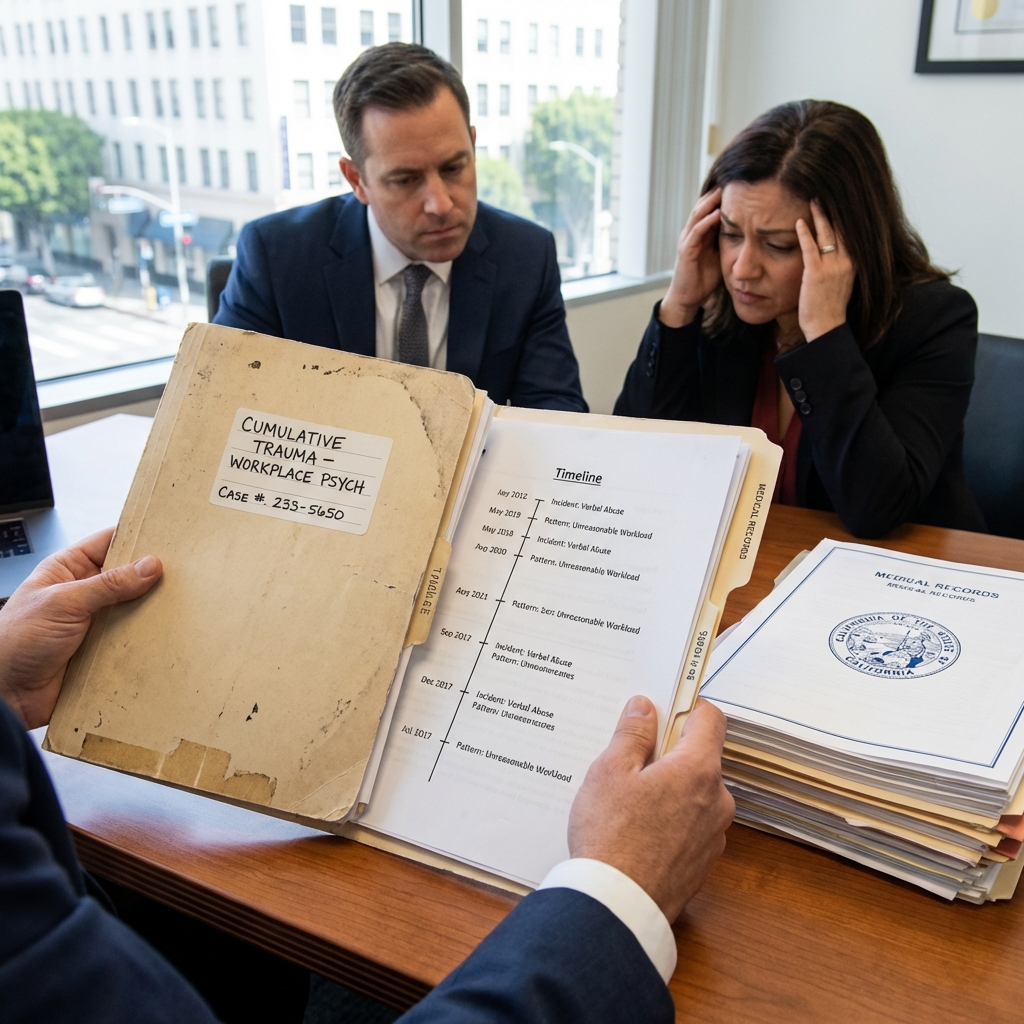
Medical documentation receives parallel attention. We refer you to treating physicians who understand workers’ compensation and cumulative trauma specifically. We prepare detailed causal history documents that your doctor can use to explain the connection between your working conditions and your diagnosis. Rather than leaving your physician to interpret legal causation standards alone, we bridge that gap.
Timeline reconstruction is another pillar of our approach. We map out the job duties that created stress, management changes that intensified pressure, or incidents of workplace conflict. A timeline showing escalating demands followed by the onset of anxiety or depression creates a compelling narrative that dates and facts support.
Medical Evidence Our Team Leverages for Your Claim
Medical evidence serves two purposes in psychological trauma claims: establishing the diagnosis and proving workplace causation. We leverage both aggressively on your behalf.
Your treating physician’s records form the foundation. Ongoing therapy notes, psychiatric evaluations, medication records, and functional impairment assessments all document the severity and timeline of your condition. We ensure these records are complete and specifically link symptoms to workplace events. A therapist’s note mentioning “patient reports anxiety increased after conflict with supervisor at work” is far more valuable than a generic anxiety diagnosis.
We also utilize occupational medicine specialists when necessary. These physicians examine you and prepare reports addressing the specific legal questions California courts require: Did the working conditions cause the psychological injury? Would the injury have developed absent those conditions? Is the injury permanent or temporary? Insurers respect occupational medicine perspectives because the specialty carries credibility in the workers’ compensation system.
Functional capacity evaluations document how the psychological injury limits your ability to work. These evaluations go beyond diagnosis and show concrete losses in concentration, memory, stress tolerance, and interpersonal functioning. Insurers take these reports seriously because they translate abstract psychological concepts into measurable work limitations.
The Critical Role of Expert Witness Testimony
Expert witness testimony often determines the outcome in disputed psychological injury cases. We carefully select experts whose qualifications align with the specific injuries you’ve experienced.
For cumulative trauma claims, we typically engage clinical psychologists or psychiatrists with experience in occupational mental health. These experts review your complete medical record, employment history, and the specific working conditions you faced. They provide opinions on whether your psychological condition meets diagnostic criteria, whether workplace factors caused it, and whether the injury is permanent. Courts and the Appeals Board weight these opinions heavily because experts frame the evidence within recognized medical and legal standards.
Cross-cultural and workplace-specific factors matter too. An expert familiar with healthcare settings can speak authoritatively about the psychological impact of repeated patient loss on nurses. An expert in organizational psychology can explain how management retaliation creates fear and anxiety. We select experts who understand your industry and the particular stressors you faced.
Expert testimony at hearings transforms the narrative. Rather than judges or the Appeals Board relying on documents alone, they hear direct expert explanation of why your psychological injury is legitimate and work-caused. The expert can address insurer arguments directly and educate the decision-maker about cumulative trauma mechanisms.
Overcoming Insurance Company Denials and Appeals
Denials are not the end of the claim. They are the beginning of our litigation strategy.
We typically see denials framed three ways: the psychological condition is not work-related, the applicant was predisposed to mental illness, or the injury doesn’t meet the threshold for workers’ compensation. Each requires different counter-evidence.
For non-work-causation denials, we present the timeline we’ve constructed, witness testimony, and medical evidence linking workplace events to symptom onset. Personal stressors may exist outside work, but our job is showing that the workplace factors predominated in causing the injury.

Predisposition arguments require expert testimony explaining that even if some predisposition existed, the working conditions were substantial enough to cause injury in a reasonable person. California law doesn’t exclude claims simply because the person was vulnerable. It asks whether the work conditions caused harm.
The appeals process itself is procedural, but we navigate it strategically. We file comprehensive trial briefs explaining how the evidence satisfies every legal element. We cross-examine the insurer’s physician when they testify. We present evidence in an order that builds momentum toward your position. We request that the Workers’ Compensation Appeals Board deny the defense arguments and award benefits.
Many cases settle during the appeals process when the insurer realizes we’ve built an overwhelming evidentiary record. We negotiate from strength, securing the best possible permanent disability award and future medical benefits for you.
Our Proven Track Record with Psychological Trauma Claims
We’ve represented hundreds of workers with cumulative psychological trauma across California. Our experience spans construction supervisors with PTSD from safety failures, teachers with anxiety from hostile work environments, healthcare workers with trauma from patient violence, and administrative staff with depression from sustained harassment.
Our success rate on cumulative trauma claims significantly exceeds statewide averages. We achieve this through the meticulous documentation process we’ve described, our relationships with qualified experts, and our litigation experience before the Appeals Board. We know the judges, the legal standards they apply, and how to present evidence persuasively within those standards.
Each case varies, but patterns emerge. Cases with contemporaneous documentation (emails, incident reports, witness statements) almost universally succeed. Cases where we engage medical experts early develop stronger evidentiary foundations. Cases where we demonstrate pattern conduct rather than isolated incidents overcome insurer skepticism more readily.
We measure success not just in claim approval but in permanent disability awards and future medical benefits that reflect the true scope of your injury. A client approved for benefits but awarded minimal permanent disability while facing lifetime mental health treatment has not achieved full justice. We fight for comprehensive awards that match the documented severity.
The Timeline and Process for Your Case Resolution
Understanding the timeline helps you plan financially and emotionally. Most cumulative trauma cases move through several phases.
Initial consultation and case evaluation occurs within days of contact. We assess whether you have a viable claim and explain the process frankly. This phase costs nothing; we operate on a contingency basis, recovering fees only if you receive benefits.
Documentation and investigation spans 4-8 weeks typically. We gather your employment records, medical files, witness statements, and incident documentation. Simultaneously, we refer you to appropriate medical providers who understand workers’ compensation and cumulative trauma.
Medical evaluation and report preparation takes 6-12 weeks. Your treating providers develop their conclusions while we prepare causal history documents supporting the claim.
Initial claim filing or defense response occurs next. If the insurer hasn’t been involved, we file formally. If they’ve already denied, we prepare the appeal.
Deposition and discovery phases involve exchanging documents and examining witnesses under oath. These phases typically consume 2-4 months and generate evidence that informs settlement discussions or trial preparation.
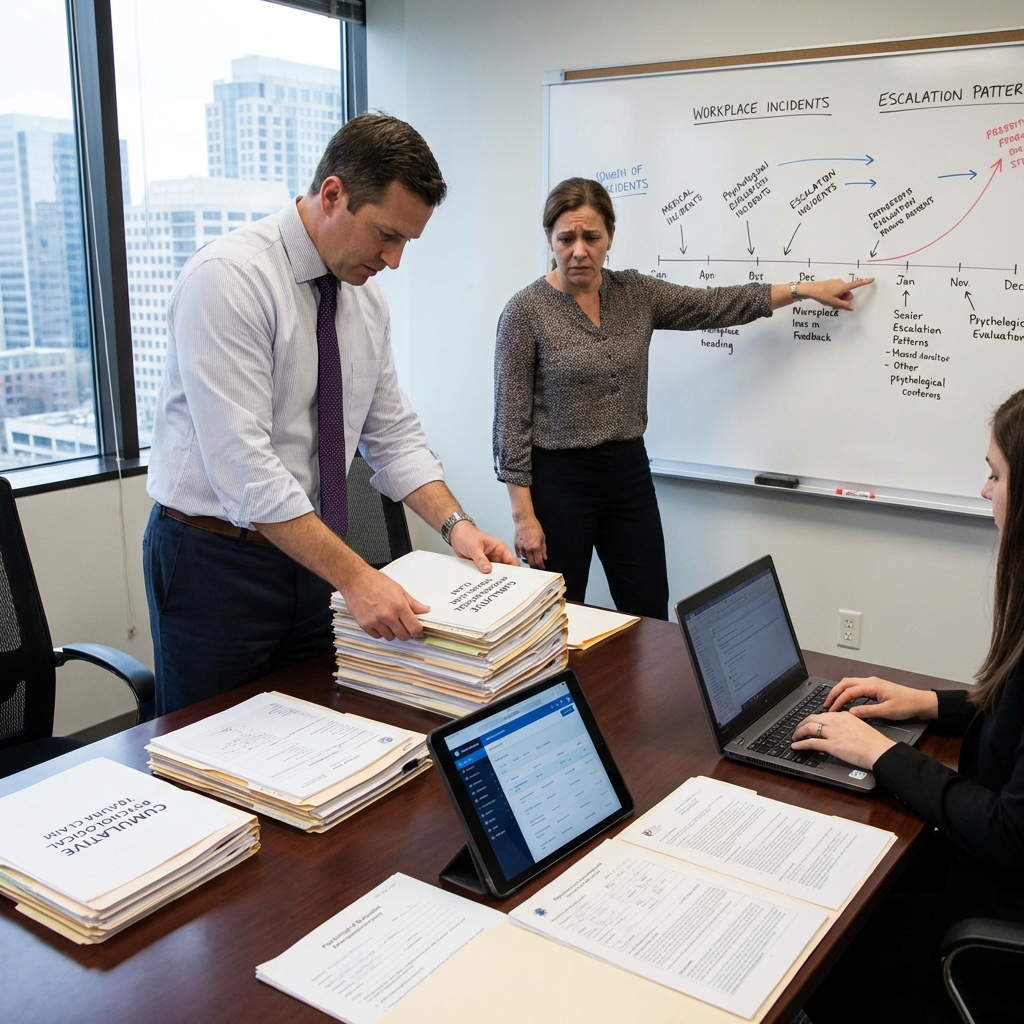
Trial before the Workers’ Compensation Appeals Board occurs if settlement discussions fail. Most cases settle before trial, but we prepare thoroughly for hearing when necessary. The entire process from initial consultation to resolution typically spans 8-14 months, though complex cases may extend longer.
Why You Need Our Specialized Expertise for Your Claim
Cumulative psychological trauma claims require a different skill set than standard workers’ compensation work. General practitioners lack the experience navigating the specific causation standards, the relationships with appropriate experts, and the litigation strategies that overcome insurer skepticism.
We’ve built our practice around occupational psychological injury. We stay current on case law changes and Appeals Board trends. We maintain networks with the medical experts who provide credible testimony. We understand industrial psychology and workplace dynamics in ways that help us frame evidence compellingly.
When you work with us, you’re leveraging more than individual legal knowledge. You’re accessing our institutional experience from hundreds of cumulative trauma cases, our reputation before the Appeals Board, and our absolute commitment to proving your claim within California’s legal framework.
We operate on a no recovery, no fee basis. You pay nothing unless we win benefits for you. This alignment means we evaluate your case carefully before accepting it and then pursue it relentlessly because our compensation depends on your success.
Your psychological injury is real. Your claim deserves representation from someone who understands cumulative trauma thoroughly and knows how to prove it to skeptical insurers. Reach out for your free consultation today. We’ll assess your situation, explain your options, and discuss how we can help you secure the benefits you’ve earned through your California employment.
For further reading: Date of cumulative trauma.
Schedule a Free Consultation Phone Number: 657 605 4418
Frequently Asked Questions (FAQ)
What counts as cumulative psychological trauma under California workers compensation law?
We consider cumulative psychological trauma to be mental health conditions that develop gradually from repeated workplace incidents or ongoing stressful conditions rather than from a single traumatic event. This might include anxiety, depression, or PTSD resulting from years of harassment, unsafe conditions, or recurring traumatic exposures in your job. Our experience shows that California recognizes these claims when we establish the specific work-related stressors that caused your condition and demonstrate a clear connection between your workplace environment and your psychological injury.
Why do insurance companies deny psychological injury claims so frequently?
We’ve found that insurers often deny these claims because psychological injuries are harder to measure objectively than physical injuries, and they require stronger medical documentation to prove causation. Insurance companies frequently argue that your mental health condition stems from personal or non-work factors unless we present compelling expert testimony and detailed medical records. We build our cases with comprehensive psychological evaluations and occupational experts who can definitively link your workplace conditions to your diagnosed condition, which significantly strengthens your position against denial.
How long does it typically take to resolve a cumulative psychological trauma claim?
We generally see these cases take between 12 to 24 months from initial claim filing to resolution, though this varies based on whether the insurance company accepts liability and whether we need to pursue litigation. The timeline depends on gathering medical evidence, obtaining expert witness reports, and potentially attending hearings or trial. We keep you informed throughout every stage so you understand what to expect and when you can anticipate receiving your benefits.