
Table of Contents
- Why Cumulative Trauma Claims Are Different from Single-Event Injuries
- The Hidden Burden: How Repetitive Workplace Stress Damages Your Health and Income
- Our Approach to Building Unbeatable Cumulative Trauma Cases
- Understanding Your Rights to Temporary and Permanent Disability Benefits
- How We Navigate Complex Medical Evidence and Insurance Company Resistance
- Why Your Free Consultation with Our Team Matters for Your Claim
- From Filing to Settlement: Our Proven Process for Cumulative Trauma Cases
- Multi-Office Advantage: Local Expertise Across California for Your Case
- What Sets Our Contingency Model Apart in Cumulative Trauma Representation
- Real Results: How We Maximize Compensation for Injured California Workers
- Frequently Asked Questions (FAQ)
Why Cumulative Trauma Claims Are Different from Single-Event Injuries
When you suffer a workplace injury from a single accident, the cause is clear: you fell from a ladder, a machine struck you, or a vehicle hit you. The timeline is obvious. A cumulative trauma claim, by contrast, stems from repeated exposure to workplace conditions over months or years. There’s no single moment where everything changed, which makes these cases fundamentally different from the ground up.
We’ve represented hundreds of workers with cumulative trauma injuries, and we’ve learned that insurance companies treat these claims with extra skepticism. They’ll argue the injury developed over time, that it may have been pre-existing, or that your work didn’t actually cause it. A single-event injury has witnesses and incident reports. A cumulative trauma claim requires us to connect the dots through medical records, work history, job descriptions, and expert testimony.
The legal standard is also stricter. California law requires us to prove that your workplace exposure was the predominant cause of your injury, not just a contributing factor. This is why specialized representation matters. We know how to gather the evidence that proves causation when the injury developed gradually rather than suddenly.
The Hidden Burden: How Repetitive Workplace Stress Damages Your Health and Income
Repetitive stress injuries are common but often go unrecognized until significant damage has already occurred. A nurse lifting patients daily, a construction worker using vibrating tools, a warehouse picker performing thousands of reaching motions, or a data entry clerk working eight hours at a keyboard all face cumulative trauma risk that compounds silently.
The financial impact extends beyond lost wages. Many of our clients describe the emotional toll: watching their earning capacity decline as pain limits their work capacity, facing skepticism from employers, and struggling through treatments while still trying to work. Some delay reporting injuries because they fear job retaliation or believe the pain will resolve on its own.
Here’s what happens medically: microtrauma accumulates. Tendons, nerves, muscles, and joints experience repeated stress that prevents full recovery between shifts. Over time, inflammation becomes chronic. Some injuries develop into conditions like carpal tunnel syndrome, rotator cuff tears, lumbar disc herniations, or psychological conditions from workplace trauma. By the time our clients consult with us, they’re often already unable to perform their jobs.
Your right to compensation doesn’t depend on whether your injury happened suddenly or developed gradually. We make sure the system recognizes the damage your work caused, regardless of the timeline involved.
Our Approach to Building Unbeatable Cumulative Trauma Cases
We start by establishing a detailed work history. We need to know exactly what you did each day, what tools you used, what positions you held your body in, and what environmental exposures you experienced. This becomes the foundation for our causation argument.
Next, we coordinate with medical experts who understand occupational medicine. These specialists examine you, review your work history, and provide opinions about how your job duties caused your injury. Their testimony carries significant weight because they can explain the mechanism of injury in clear, scientific terms that juries understand.
We also obtain comprehensive medical records spanning years if necessary. Insurance companies look for gaps or inconsistencies, so we build a complete picture of how your condition developed. Early complaints to supervisors, visits to occupational health clinics, or even informal treatments all become part of the narrative.
Our case strategy differs based on your specific situation. Construction workers with cumulative trauma from repetitive motion, vibration, or awkward postures need different documentation than office workers with psychological cumulative trauma. We tailor our approach to your industry and injury type.
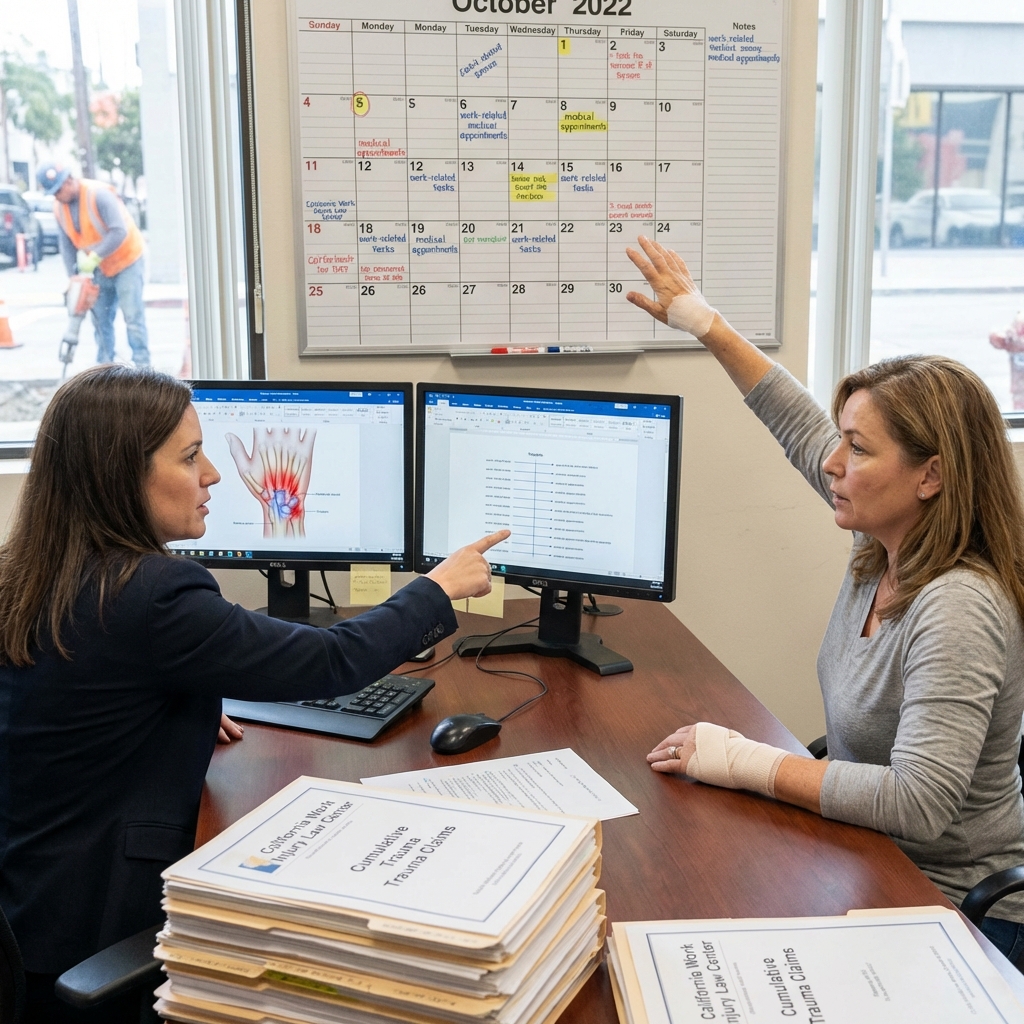
Document preservation is critical. We identify and secure all relevant materials: job descriptions, safety protocols, equipment specifications, prior worker complaints, OSHA records, and payroll documentation. Once litigation begins, opposing counsel will scrutinize everything, so we get ahead of that process.
Understanding Your Rights to Temporary and Permanent Disability Benefits
California’s workers’ compensation system provides two types of disability benefits, and understanding which applies to you directly affects your case value.
Temporary disability benefits replace your wages while you’re treating your injury and unable to work. These benefits run from the date your injury prevents you from working until either you fully recover or reach maximum medical improvement. If your cumulative trauma claim results in months of treatment and lost work, temporary benefits can amount to substantial income replacement.
Permanent disability benefits apply when you’ve reached maximum medical improvement but retain lasting effects from your injury. If cumulative trauma left you with chronic pain, reduced strength, limited range of motion, or other ongoing limitations, you’re entitled to permanent benefits based on the severity of your impairment and your age, occupation, and pre-injury earnings.
We’ve seen cases where injured workers accept inadequate settlement offers because they don’t understand the full scope of benefits they deserve. The difference between settling for temporary benefits alone versus securing both temporary and permanent disability compensation can be tens of thousands of dollars.
Your specific benefits depend on your medical condition, your ability to return to work, and the insurance company’s willingness to acknowledge the full extent of your injury. This is where we advocate aggressively on your behalf.
How We Navigate Complex Medical Evidence and Insurance Company Resistance
Insurance adjusters use standard evaluation tables and formulas to minimize what they pay. They’ll argue your impairment rating is lower than our medical experts conclude. They’ll challenge whether your job truly caused the injury. They’ll suggest that pre-existing conditions, age, or other factors bear responsibility.
We counteract this resistance with detailed medical evidence and expert testimony. When the insurance company’s physician provides an opinion we disagree with, we have independent occupational medicine specialists reexamine you and provide counter-opinions. We’re not intimidated by the insurance company’s experts because we’ve cross-examined them before.
Documentation is our weapon here. We build a chronological record showing symptom progression, treatment attempts, and functional decline. We obtain detailed job analysis reports that describe exactly what your work required. We gather expert opinions explaining the biomechanical or psychological mechanisms linking your job to your injury.
Many cumulative trauma cases involve complex causation issues. Psychological cumulative trauma from workplace harassment or discrimination requires different proof than repetitive stress injuries. We know how to present these cases because we handle them regularly.
When insurers deny claims or underpay, we escalate to formal disputes and litigation if necessary. Our clients don’t accept lowball offers because we’ve thoroughly documented the true value of their claims.
Why Your Free Consultation with Our Team Matters for Your Claim
A free initial consultation with us serves multiple purposes. You get to explain your situation to someone who understands workers’ compensation law and industry-specific injuries. We listen for details that matter: the exact nature of your work, when symptoms started, what treatments you’ve tried, and how the injury has changed your life.
During our consultation, we evaluate whether your case has merit under California law. Some injuries don’t qualify as occupational cumulative trauma, and we’re honest about that. Most injured workers we meet have valid claims, but the strength varies. We tell you clearly what we see.
We also assess the insurance company’s likely response. Based on your injury type, your industry, and the medical evidence, we predict how aggressively they’ll contest your claim. This helps you understand what to expect.

Many workers don’t seek legal help because they assume injury cases are straightforward. A consultation reveals the complexity. Insurance companies have teams of adjusters and defense attorneys. You benefit from having an expert in your corner from the beginning, not after months of negotiations have damaged your claim.
We represent cumulative trauma cases on contingency, meaning you pay no upfront fees. Our consultation is truly free, and if we take your case, you pay only if we recover compensation for you.
From Filing to Settlement: Our Proven Process for Cumulative Trauma Cases
Our process begins immediately after we agree to represent you. We file your workers’ compensation claim if one hasn’t been filed already, ensuring all deadlines are met and your notice of injury reaches the right parties.
Once filed, the claim enters the insurance company’s investigation phase. We gather evidence simultaneously: medical records, work history documentation, expert evaluations, and job analysis reports. We communicate directly with the insurance adjuster to establish our position early.
Most cumulative trauma cases settle before litigation becomes necessary. We prepare settlement packages that comprehensively document your injury, its causation, your medical treatment, your wage loss, and your permanent impairment. We present this to the insurance company with a settlement demand backed by solid evidence.
If the insurance company’s offer falls short of what your case is worth, we prepare for litigation. This involves deposing the insurance company’s medical experts, developing trial testimony from our experts, and building the narrative that connects your job duties to your injury. We’re comfortable taking cases to trial because we’ve tried many.
The appeals process exists if either side disagrees with the workers’ compensation judge’s decision. We handle appeals when necessary, and our appellate experience ensures your case is presented persuasively to the appeals board.
Throughout this process, we keep you informed. You understand what’s happening, why we’re making strategic choices, and what to expect next.
Multi-Office Advantage: Local Expertise Across California for Your Case
We maintain offices throughout California because cumulative trauma cases differ by region and industry. Construction injuries in the San Francisco Bay Area have different characteristics than agricultural injuries in the Central Valley. Healthcare worker injuries in Los Angeles differ from tech industry injuries in Silicon Valley.
Our multiple locations mean we have attorneys and staff who understand local labor practices, common workplace hazards in your area, and the specific medical professionals who treat occupational injuries near you. We coordinate with local medical experts who know regional workplace conditions.
Regional knowledge also helps us navigate local workers’ compensation courts and appeals boards. We understand how judges in your district typically rule on cumulative trauma cases, which helps us shape our presentation and settlement strategy accordingly.
If you need to meet with us in person, we’re likely accessible near your home or workplace. This reduces friction and makes it easier for you to receive the representation you deserve.
What Sets Our Contingency Model Apart in Cumulative Trauma Representation
We operate exclusively on contingency for cumulative trauma cases and other workers’ compensation claims. This means we’re paid only if we recover compensation for you, and our fee comes from that recovery. You pay nothing upfront, and you’re never billed hourly.
This arrangement aligns our interests completely with yours. We’re motivated to maximize your recovery because that increases our fee. We’re not incentivized to settle quickly for inadequate amounts. We take the time necessary to build your case properly because we only get paid when we win.
Many injured workers hesitate to hire attorneys because they assume legal fees will consume a large portion of their recovery. Our contingency model removes that barrier. You can afford representation because you only pay if we succeed.
We’re also selective about cases we accept. Because we’re paid from recovery, we only take cases we believe are strong enough to win. This discipline means we don’t waste your time or resources on marginal claims. Our acceptance rate is higher because we focus on cumulative trauma cases we understand thoroughly.
Real Results: How We Maximize Compensation for Injured California Workers
Over years of representing injured workers, we’ve secured substantial recoveries in cumulative trauma cases. Our clients receive compensation for temporary disability, permanent disability, medical treatment, and in some cases, vocational rehabilitation benefits.
A construction worker with shoulder and elbow injuries from years of overhead work received permanent disability benefits and vocational rehabilitation to transition to less physically demanding work. A healthcare worker with psychological cumulative trauma from patient violence and understaffing secured a settlement that recognized the psychiatric injury as work-caused. A warehouse worker with lumbar disc herniations resulting from repetitive lifting and awkward positioning recovered both temporary and permanent benefits.
These results reflect our detailed approach to case development. We don’t accept insurance company valuations without challenge. We demand the compensation our clients actually deserve based on the severity of their injuries, their lost earning capacity, and the permanence of their conditions.
Your recovery should reflect the true impact of your work injury on your life. We fight for that standard in every case.
If you’ve suffered a cumulative trauma injury in California, contact us for your free consultation. We’ll evaluate your claim, explain your rights, and tell you exactly what we believe your case is worth. You deserve representation by attorneys who specialize in cumulative trauma and understand the nuances of California workers’ compensation law. Let’s build your case together.
Schedule a Free Consultation Phone Number: 657 605 4418
Frequently Asked Questions (FAQ)
What is a cumulative trauma claim, and how is it different from a single workplace injury?
A cumulative trauma claim involves injuries that develop gradually over time through repetitive stress, poor ergonomics, or ongoing workplace conditions rather than a single accident or event. We handle these cases because they require different evidence and strategies than acute injuries, such as detailed medical documentation showing the progression of your condition and how specific job duties contributed to your injury. Insurance companies often resist cumulative trauma claims, which is why we build comprehensive cases with solid medical records and expert testimony.
What should I expect during the free consultation with our team?
During our consultation, we listen to your work history and medical situation to evaluate your claim’s strength and potential compensation value. We ask detailed questions about your job duties, when symptoms started, and what medical treatment you have received to understand the full scope of your case. You’ll leave with a clear picture of your rights and next steps, with no obligation or cost to you.
How does your no recovery, no fee model work for cumulative trauma cases?
We represent you on a contingency basis, meaning we only collect a fee if we secure compensation for you through settlement or judgment. This arrangement allows us to take on challenging cumulative trauma cases without creating financial burden for injured workers, and it aligns our interests directly with your success. You pay nothing out of pocket for our legal services throughout the entire process.