
Table of Contents
- How Cumulative Hearing Loss Develops in the Workplace
- Why Hearing Loss Claims Are Often Overlooked by Insurance Companies
- Documenting Your Occupational Hearing Damage: The Critical Evidence We Gather
- Medical Evidence and Audiological Testing Requirements for Your Claim
- Calculating Permanent Disability Benefits for Hearing Loss Injuries
- Psychological Trauma Claims Connected to Hearing Loss and Workplace Injury
- Our No Recovery, No Fee Approach to Hearing Loss Cases
- Common Employer and Insurance Defense Tactics We Counter
- How We Navigate California Workers Compensation Law for Cumulative Injuries
- Your Path Forward: Filing Your Hearing Loss Claim With Our Team
- Frequently Asked Questions (FAQ)
How Cumulative Hearing Loss Develops in the Workplace
Hearing loss from workplace noise exposure is one of California’s most prevalent occupational injuries, yet many workers never pursue the compensation they’re entitled to receive. If you’ve spent years in a loud industrial environment, construction site, or manufacturing facility and notice your hearing has deteriorated, you likely have a valid cumulative trauma injury claim. At California Work Injury Law Center, we’ve helped hundreds of workers in your situation navigate the complexities of hearing loss workers’ compensation claims and secure the permanent disability benefits they deserve.
Hearing loss develops gradually, making it easy for both workers and employers to downplay its severity until significant damage has occurred. Insurance companies routinely deny or underpay these claims because the injury isn’t dramatic like a broken bone or acute trauma. Our role is to build an irrefutable case that demonstrates your occupational hearing damage, quantifies your permanent disability, and holds your employer and their insurer accountable.
Noise-induced hearing loss accumulates over time through repeated exposure to sound levels above 85 decibels. Construction sites, manufacturing plants, airports, military installations, and even some hospitality venues generate noise at levels that damage the sensitive hair cells in your inner ear. Each exposure causes microscopic damage, and because the ear cannot repair these cells, the damage compounds year after year.
Common high-risk occupations include:
- Construction workers (pneumatic drills, jackhammers, heavy equipment)
- Manufacturing facility workers (machinery, assembly lines)
- Military personnel (weapons training, aircraft operations)
- Airport ground crew and maintenance workers
- Railway and transportation workers
- Mining and quarry operators
- Musicians and concert venue staff
The insidious nature of occupational hearing loss is that workers often don’t realize significant damage has occurred until they struggle to hear conversations or experience tinnitus. By that time, years or decades of cumulative exposure have typically passed. Unlike a single traumatic incident, your claim must establish a clear timeline of noise exposure and documented hearing decline.
Why Hearing Loss Claims Are Often Overlooked by Insurance Companies
Insurance carriers actively undervalue hearing loss claims because they argue the condition is common to aging and difficult to prove was caused exclusively by workplace exposure. They’ll claim you could have damaged your hearing through personal activities like attending concerts, using loud headphones, or other non-occupational noise sources. This convenient defense allows them to deny or minimize your claim substantially.
We’ve seen insurers rely on several tactics:
- Suggesting your hearing loss is age-related, not occupational
- Questioning the accuracy of audiological testing
- Claiming insufficient documentation of noise exposure levels
- Disputing the permanence of your hearing loss
- Offering settlements far below what permanent disability benefits should provide
Another reason these claims get overlooked is that many workers don’t file them at all. They assume hearing loss is simply part of working in their industry or believe the claim will be too complicated to pursue. This passive acceptance leaves thousands of California workers uncompensated for a preventable, permanent disability.
Documenting Your Occupational Hearing Damage: The Critical Evidence We Gather
Strong documentation is the foundation of any successful hearing loss cumulative trauma claim. We work systematically to compile evidence that establishes your occupational exposure and connects it directly to your hearing damage.
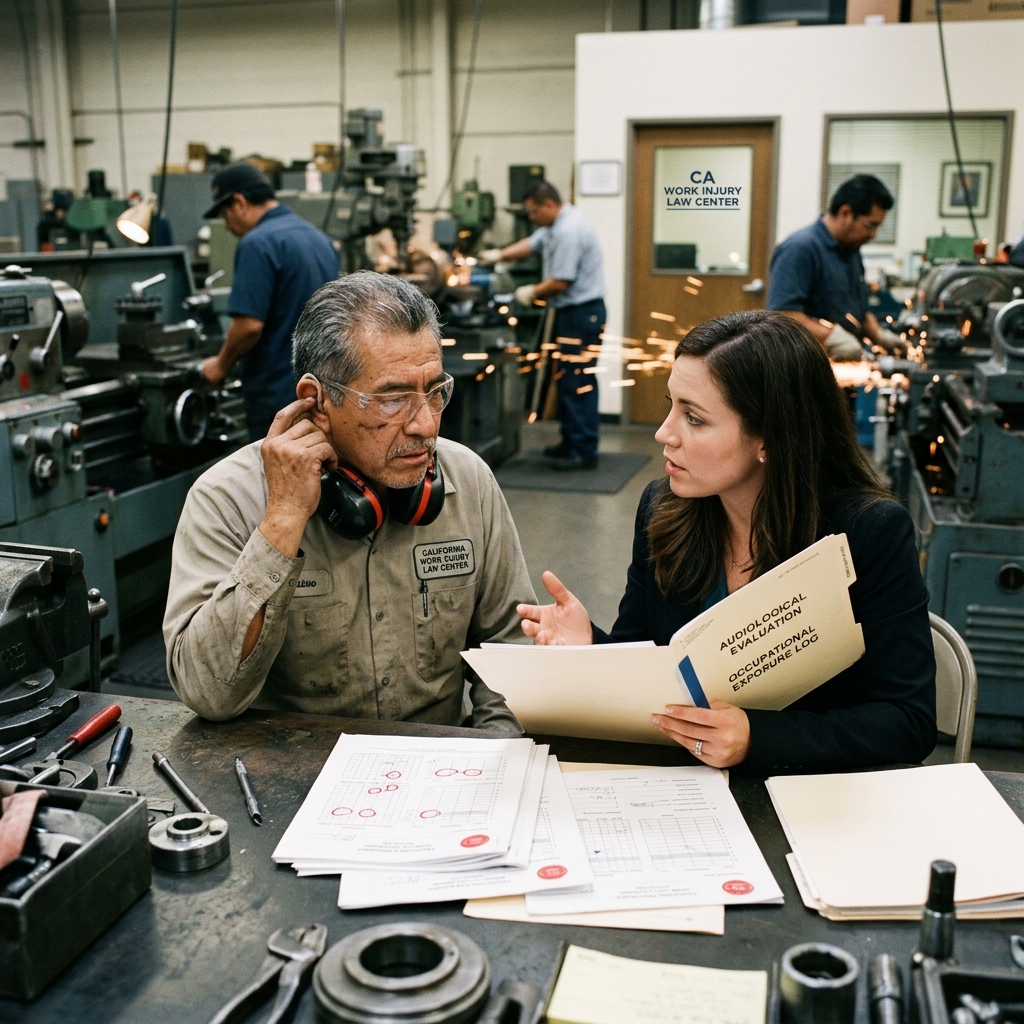
Our investigation typically includes:
- Detailed work history spanning the entire period of exposure
- Employer records showing noise level measurements at your worksite
- OSHA documentation and safety reports from your employer
- Witness statements from coworkers who experienced similar noise exposure
- Photos and video evidence of your actual work environment
- Your personal records of hearing protection use (or lack thereof)
- Timeline of when you first noticed hearing difficulties
We also gather evidence about whether your employer provided adequate hearing protection, conducted baseline hearing tests, or monitored your hearing health over time. Many California employers fail to implement proper hearing conservation programs despite legal requirements, and this negligence strengthens your case significantly.
Personal documentation matters too. Bring us any medical notes mentioning hearing problems, communications with your employer about noise concerns, and records of your own attempts to address the issue. Even informal notes demonstrating when your hearing problems began are valuable.
Medical Evidence and Audiological Testing Requirements for Your Claim
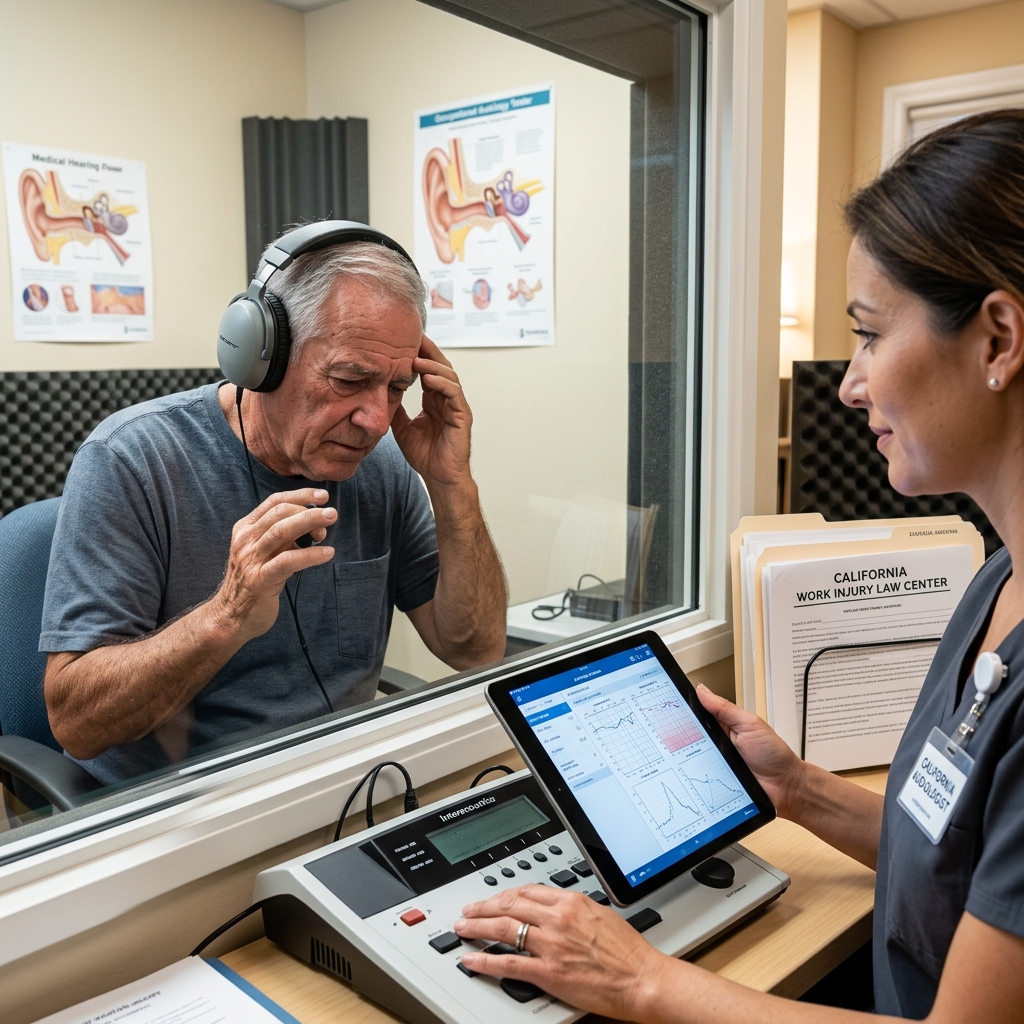
Your claim requires current audiological testing to establish your present hearing status and compare it against any baseline testing from when you began your job. We coordinate with qualified audiologists who understand workers’ compensation claims and can perform testing that meets legal standards.
The key medical evidence includes:
- Baseline audiometry (if available from your employer)
- Current audiometry showing your present hearing threshold
- Comparison showing measurable hearing loss in occupational noise frequency ranges
- Audiologist’s report linking your hearing loss pattern to noise exposure
- Medical causation opinion from an occupational medicine physician
- Documentation of any related conditions like tinnitus
California requires objective, measurable evidence of hearing loss. An audiological test establishes your current hearing across different frequencies. The pattern of your loss matters: occupational noise exposure typically affects hearing in the 3,000 to 6,000 Hz range first, which is distinctive compared to age-related hearing loss patterns.
We’ll arrange independent medical evaluations if your employer’s insurer contests the claim. Having your own medical expert willing to testify about causation prevents the insurance company from relying solely on their own chosen physician.
Calculating Permanent Disability Benefits for Hearing Loss Injuries
California’s Permanent Disability Rating Schedule (PDRS) provides specific formulas for calculating hearing loss benefits based on your audiological test results. The rating isn’t arbitrary; it’s based on measurable hearing thresholds across multiple frequencies and your age at the time of injury.
The calculation process considers:
- Your binaural hearing impairment percentage
- Your age when the hearing loss became permanent
- The applicable PDRS tables for your injury year
- Whether you require hearing aids or other assistive devices
- Any impact on your ability to perform your job
Most occupational hearing loss cases result in permanent disability ratings ranging from 5% to 30%, depending on severity. At current California rates, a 15% permanent disability rating translates to substantial monetary compensation. We’ve secured awards exceeding $50,000 for workers with significant cumulative hearing loss, and higher amounts when wage loss or future medical treatment is involved.
The timeline matters: your rating is typically calculated based on your age when you reach maximum medical improvement. We fight to ensure this calculation reflects your actual hearing impairment, not reduced percentages that insurers sometimes try to impose.
Psychological Trauma Claims Connected to Hearing Loss and Workplace Injury
Hearing loss frequently triggers anxiety, depression, and social isolation that qualify as compensable psychological injury under California law. The inability to hear conversations, participate in social activities, or perform your job duties creates genuine emotional distress that deserves recognition and compensation.
We’ve successfully pursued combined claims that include:
- The primary occupational hearing loss injury
- Psychological trauma from the hearing loss itself
- Anxiety related to workplace safety and future injuries
- Depression stemming from social isolation or career limitations
- Post-traumatic stress if the hearing damage occurred alongside acute trauma
Your occupational injury must be the substantial cause of the psychological injury, which is straightforward in hearing loss cases. The hearing damage is documented, and the psychological consequences are predictable and well-established in medical literature. An occupational psychologist or psychiatrist can provide expert testimony about the causal connection and the extent of your emotional suffering.
Our No Recovery, No Fee Approach to Hearing Loss Cases
We represent injured California workers on a contingency basis: you pay no attorney fees unless we recover compensation for you. This aligns our interests directly with yours. We advance case costs including medical evaluations, expert witness fees, and investigation expenses, recovering these costs only if we win or settle your claim successfully.
This approach removes financial barriers to accessing legal representation. You shouldn’t have to choose between filing a legitimate claim and worrying about legal costs if the case doesn’t succeed. With our contingency model, you can pursue your hearing loss claim with confidence.
We handle every aspect of your case: initial consultation, claim filing, evidence gathering, negotiation with the insurance company, and litigation if necessary. You focus on your health and recovery while we manage the legal complexities.
Common Employer and Insurance Defense Tactics We Counter
Insurance carriers defending hearing loss claims deploy predictable strategies that we’ve countered successfully for years. Anticipating these defenses strengthens our negotiating position and trial preparation.
Standard defense arguments include:
- “Your hearing loss is age-related, not occupational” – We rebut this with audiological evidence showing the distinctive frequency pattern of noise-induced hearing loss, expert testimony, and baseline comparisons if available.
- “You didn’t use hearing protection consistently” – Worker non-compliance doesn’t eliminate employer responsibility; many California employers failed to provide proper equipment or enforce usage.
- “Noise levels at your worksite weren’t excessive” – We gather OSHA records, conduct sound level measurements, and produce expert testimony about actual exposure.
- “Your hearing loss isn’t permanent” – Sensorineural hearing loss from noise exposure is permanent; hair cells in the inner ear cannot regenerate.
- “You had pre-existing hearing loss” – Occupational exposure still caused measurable additional damage, which we quantify through careful audiological analysis.
We proactively address these defenses during claim preparation rather than being surprised by them during settlement negotiations or trial.
How We Navigate California Workers Compensation Law for Cumulative Injuries
Cumulative injury claims operate under different legal standards than acute injuries. You don’t need to identify a specific date when hearing loss occurred; instead, you establish that your job duties exposed you to harmful conditions over an extended period that caused your hearing damage.
California’s workers’ compensation system recognizes cumulative trauma claims when workers develop conditions through repetitive activities or prolonged exposure. Hearing loss fits this category perfectly. The statute of limitations begins when you knew (or should have known) your condition was work-related, giving you time to file even if hearing damage occurred years ago.
Key legal principles we apply:

- Cumulative injury liability exists when job duties caused repeated harmful exposure
- You don’t need an exact date of injury, only proof of exposure and causation
- Medical causation opinions must establish the work was a substantial cause
- Your employer’s insurer remains liable even if you’ve changed jobs since the exposure
- Permanent disability benefits are owed regardless of whether you can still perform your job
The burden of proof in workers’ compensation is typically lower than in civil lawsuits, which works to your advantage. We present evidence showing your occupation exposed you to noise levels known to cause hearing damage, you developed measurable hearing loss with a pattern consistent with noise exposure, and no other cause adequately explains your condition.
Your Path Forward: Filing Your Hearing Loss Claim With Our Team
The first step is scheduling a free legal consultation where we’ll review your work history, discuss your hearing loss symptoms, and evaluate your claim’s strength. We assess whether you have sufficient occupational exposure, documented hearing damage, and clear causation to pursue compensation successfully.
During the consultation, bring:
- Documentation of your employment history and job descriptions
- Any existing hearing test results or medical records mentioning hearing problems
- Photos of your work environment if you have them
- Names of coworkers who experienced similar noise exposure
- Records of any complaints you filed about workplace noise conditions
After we take your case, we’ll handle the entire claims process. We’ll arrange necessary audiological testing, retain occupational medicine and toxicology experts as needed, file your claim with the California workers’ compensation system, and negotiate with your employer’s insurer. If settlement discussions don’t yield fair compensation, we’re prepared to litigate your case aggressively.
Our goal is securing maximum permanent disability benefits, covering future medical treatment related to your hearing loss, and ensuring you receive any additional compensation for wage loss or psychological injury. With our no recovery, no fee model, you have nothing to lose by consulting with us.
Contact California Work Injury Law Center today for your free consultation. We have multiple office locations throughout California and can discuss your hearing loss cumulative trauma claim in detail. Your occupational hearing damage is legitimate, documentable, and compensable. Let us fight to secure the benefits you’ve earned through years of workplace exposure.
Schedule a Free Consultation Phone Number: 657 605 4418
Frequently Asked Questions (FAQ)
What evidence do we need to build a strong hearing loss cumulative trauma claim?
We gather comprehensive documentation including your work history, exposure records to noise levels, and audiological testing results that establish a baseline and show deterioration over time. Our team also obtains medical expert opinions connecting your hearing loss directly to workplace conditions and collects employer safety records or lack thereof. This multi-layered approach makes it difficult for insurance companies to deny the occupational origin of your injury.
Why do insurance companies frequently deny or undervalue hearing loss claims?
We’ve found that insurers often dispute hearing loss claims because the injury develops gradually, making causation appear unclear compared to acute workplace injuries. They may argue that age or non-work factors caused your hearing damage, or they underestimate the permanent disability rating to minimize benefit payments. Our experience countering these specific defense tactics allows us to present evidence that isolates workplace noise exposure as the primary cause of your cumulative hearing injury.
How does our no recovery, no fee model work for hearing loss cases?
We handle your case entirely at no upfront cost to you, and we only collect attorney fees if we successfully secure compensation through settlement or trial verdict. This approach aligns our interests directly with yours because we’re fully invested in maximizing your benefits. You can pursue your claim without financial risk while we manage all legal complexities.