
Table of Contents
- Why Forklift Accidents Demand Immediate Legal Action
- How Forklift Injuries Differ From Standard Workplace Claims
- Your Rights to Temporary and Permanent Disability Benefits
- Proving Negligence in Forklift Accident Cases
- Common Injuries From Forklift Accidents We Successfully Handle
- Why Our No Recovery, No Fee Model Protects You
- How We Navigate Complex Employer and Third-Party Liability
- Documentation and Evidence We Gather for Your Case
- Settlement Negotiations and Litigation Strategy
- Your Next Steps: Free Consultation With Our Team
- Frequently Asked Questions (FAQ)
Why Forklift Accidents Demand Immediate Legal Action
Forklift accidents represent some of the most serious workplace incidents we handle at California Work Injury Law Center. These collisions cause severe injuries, create complex liability questions, and often involve multiple responsible parties. If you’ve been injured in a forklift accident across California, understanding your legal rights and recovery options becomes critical to securing the compensation you deserve.
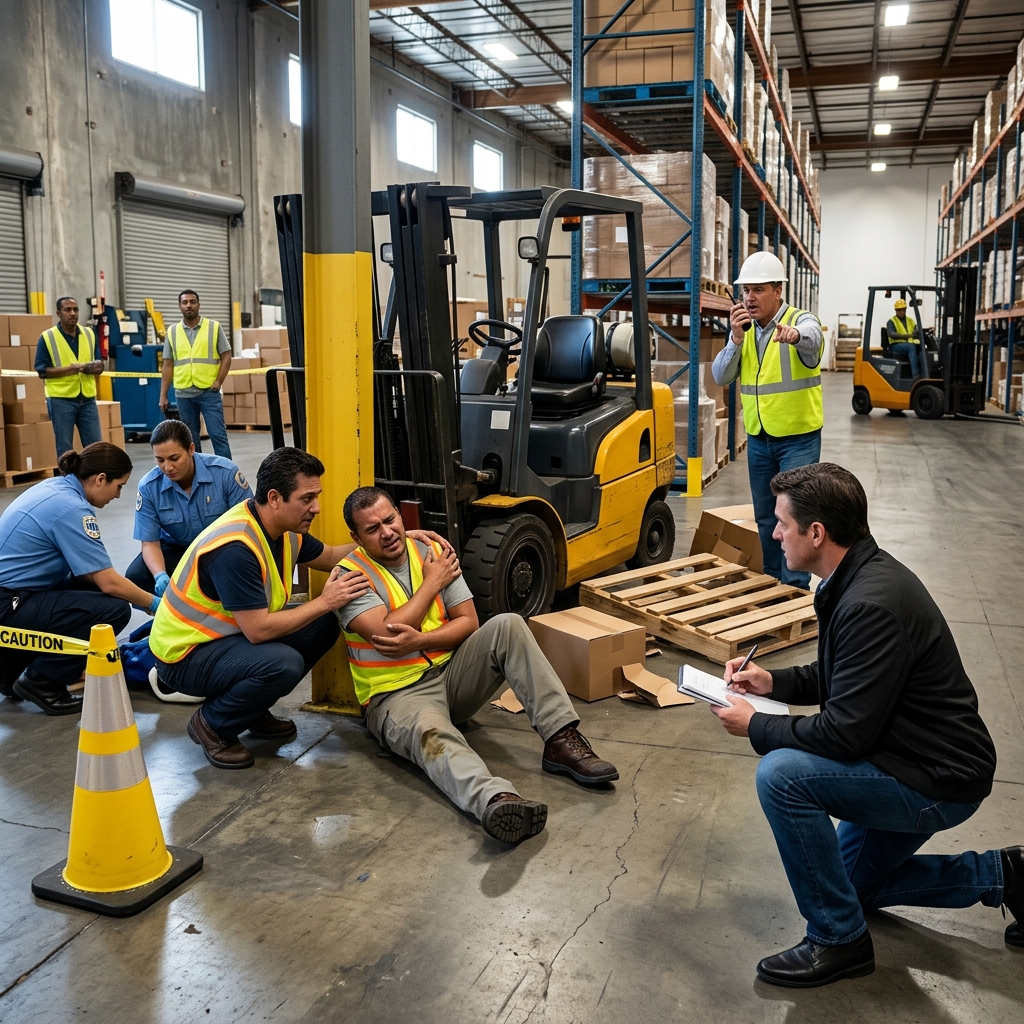
Forklift accidents are deceptively serious. A machine weighing several tons moving at modest speeds generates tremendous force, and the operator often has limited visibility. Workers struck by forklifts, caught beneath loads, or crushed during tipping incidents suffer catastrophic injuries that change their lives permanently.
The immediate aftermath matters enormously. Evidence deteriorates, witness memories fade, and employers may begin limiting access to safety records and incident documentation. We’ve seen too many injured workers wait weeks or months before contacting legal counsel, only to discover critical evidence has vanished or been altered.
Beyond physical recovery, forklift accidents introduce legal complexity early. Your employer’s insurance carrier will assign an adjuster within days. That adjuster’s job is to minimize payout, not protect your interests. Without legal representation from the start, you may unknowingly make statements that undermine your claim or accept settlement offers far below what your case actually justifies.
What to do next: Contact us within the first two weeks after your accident. This window allows us to preserve evidence, interview witnesses while details remain fresh, and begin building your case before insurance adjusters can control the narrative.
How Forklift Injuries Differ From Standard Workplace Claims
Forklift accident cases differ fundamentally from typical workplace injuries because equipment failure, operator error, inadequate training, and workplace design all create potential liability pathways that standard slip-and-fall or repetitive strain claims don’t present.
In a standard workers’ compensation claim, you receive benefits regardless of fault. Your employer’s workers’ compensation insurance covers you, and you generally cannot sue your employer. However, forklift accidents frequently open doors to third-party liability claims. If the forklift manufacturer failed to include adequate safety features, if a third-party maintenance company improperly serviced the equipment, or if a contractor on your worksite operated the forklift negligently, you may pursue separate litigation against those parties outside the workers’ compensation system.
Construction sites amplify this complexity. Multiple employers and contractors often work simultaneously, creating jurisdictional questions about responsibility. A forklift operator employed by one subcontractor injuring a worker from another company creates immediate questions about comparative fault and insurance coverage.
Equipment defects add another dimension. Modern forklifts should include backup alarms, stability systems, and load capacity indicators. If your accident involved a machine lacking standard safety features, we investigate whether the manufacturer bears responsibility for your injuries.
What to do next: Identify and document all parties present at the accident scene, including equipment manufacturers, maintenance contractors, and other employers. This information forms the foundation for identifying potential third-party defendants.
Your Rights to Temporary and Permanent Disability Benefits
California law guarantees injured workers two essential benefit categories. Temporary disability benefits replace lost wages while you recover and cannot work. These benefits continue throughout your healing period, whether that’s six weeks or six months.
Calculating temporary disability benefits is straightforward: you receive two-thirds of your average weekly wage, capped at a state maximum. If you earned $1,200 weekly, you’d receive approximately $800 weekly in temporary disability payments. These continue until your treating physician releases you to full duty, you reach maximum medical improvement, or you exhaust your benefit period.
Permanent disability benefits address lasting impairment after maximum medical improvement is reached. If your forklift injury leaves you unable to perform your prior job or any comparable employment, you qualify for permanent disability compensation. This might mean reduced earning capacity, permanent pain or limitation, or complete work inability.
The permanent disability rating depends on factors like your age, occupation, extent of injury, and future earning capacity. A 45-year-old construction foreman with a permanent back injury qualifies for substantially higher permanent disability compensation than a 25-year-old with the same injury, because the younger worker has more years to adapt and retrain.
We fight to maximize both benefit categories. Insurance carriers frequently undervalue permanent disability cases, offering lump sums insufficient to cover lifetime lost earning capacity. Our role is ensuring you receive what the law truly entitles you to.
What to do next: Begin documenting all medical treatment, work restrictions, and earnings impact from day one. Keep records of any job offers you cannot accept due to your injury.
Proving Negligence in Forklift Accident Cases
When third-party liability exists, negligence becomes your central legal theory. California courts require four elements: a duty of care, breach of that duty, causation, and damages. In forklift cases, we prove these systematically.
Duty of care is straightforward. Equipment manufacturers must design safe products. Employers must maintain equipment and provide proper training. Operators must maintain control of dangerous machinery. Contractors sharing worksites must coordinate safely.
Breach is where investigation matters most. Was the forklift improperly maintained, with worn brakes or hydraulic failures? Did training records show operators lacked certification? Did the manufacturer omit safety features present in competitor models? We obtain maintenance logs, training documentation, prior accident reports, and manufacturer specifications.
Causation requires establishing that the breach directly caused your injury. If a forklift lacked a backup alarm and you were struck while the operator couldn’t see you, the missing safety feature caused your injury. This causation chain must be direct and provable.
Damages are everything you’ve suffered: medical expenses, lost wages, pain and suffering, permanent disability, and reduced quality of life. We document every impact your injury created.
What to do next: Preserve all accident scene photographs, equipment documentation, and communications about the incident. Do not allow anyone to move, repair, or alter the forklift before we can have it inspected.
Common Injuries From Forklift Accidents We Successfully Handle
Forklift accidents create injuries across a spectrum of severity. Crush injuries occur when loads or the machine itself pin workers against fixed objects or the ground. These often result in fractures, internal bleeding, and permanent disability.
Struck-by injuries happen when workers are hit by moving equipment or falling loads. These cause head trauma, spinal injuries, internal organ damage, and traumatic brain injury.
Overturned forklift accidents, particularly on slopes or uneven ground, can trap operators beneath multi-ton equipment. These result in severe crush injuries, spinal cord damage, and catastrophic trauma.
We’ve successfully represented workers with amputation injuries, permanent paralysis, severe traumatic brain injury, chronic pain syndromes, and psychological trauma. Some clients suffered temporary injuries requiring weeks of recovery. Others face lifetime disability requiring ongoing medical care and assistance.
The diversity of these injuries means every case demands individualized investigation and strategy. A hand crush injury differs dramatically from spinal cord paralysis in terms of permanent impact, rehabilitation needs, and settlement value.
What to do next: Obtain copies of all medical imaging, surgical reports, and specialist evaluations. These documents establish injury severity and permanence.
Why Our No Recovery, No Fee Model Protects You
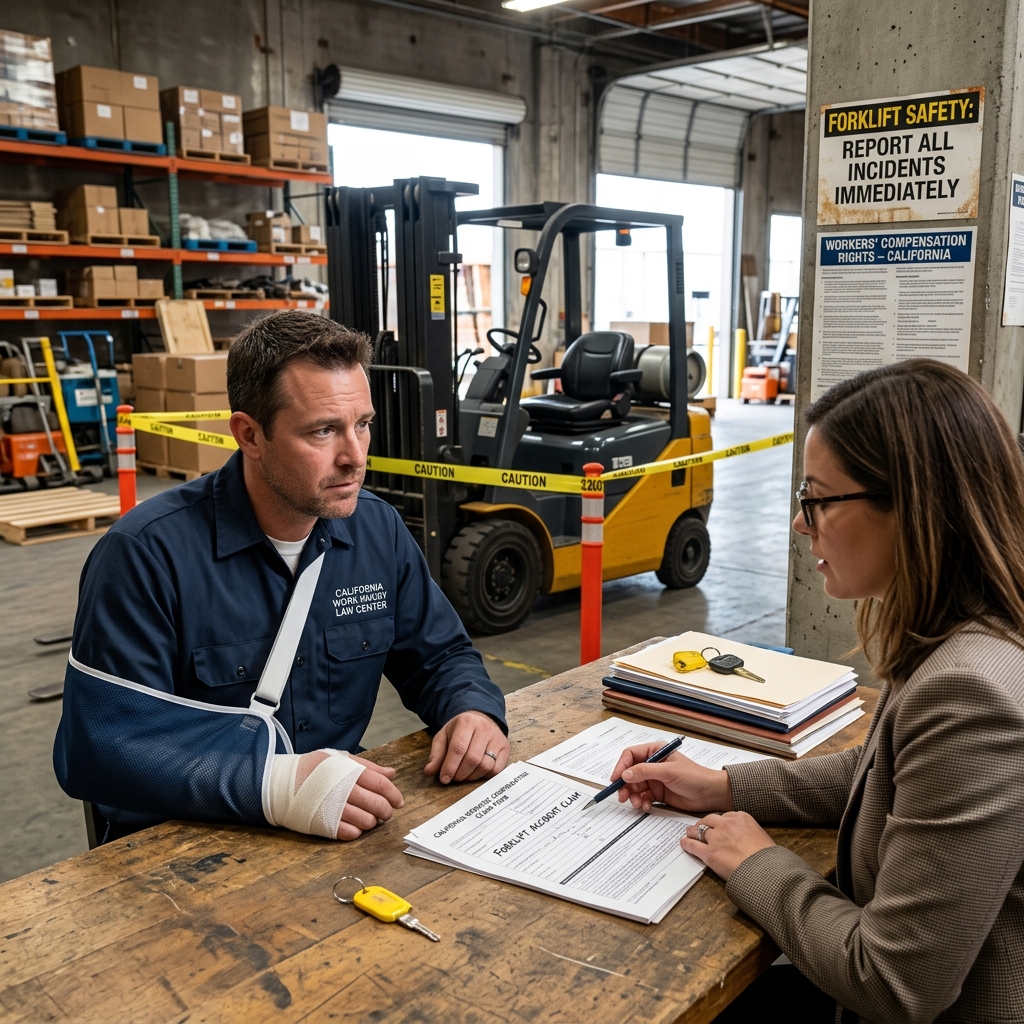
We operate on a contingency fee basis: we recover no fee unless we win your case. This aligns our interests perfectly with yours. Our success depends entirely on securing compensation for you. We don’t collect payment from adjuster settlements or insurance company negotiations. We win, you pay us a percentage. We lose, you pay nothing.
This model eliminates financial barriers to legal representation. You won’t face hourly billing of $300-$500 per hour that makes hiring lawyers impossible for injured workers on disability benefits. You won’t worry about accumulating legal bills while fighting for your rights. You invest nothing upfront and pay us only from your recovery.
We also advance case costs. We pay for medical records, accident scene investigation, expert testimony, and medical evaluation costs. If your case requires independent medical examination to counter the insurance carrier’s narrative, we cover that expense. You never risk personal debt funding your case.
This arrangement reflects our confidence in your claim. We’ve evaluated forklift accident cases for twenty-plus years. We know which cases we can win. We accept representation knowing we can recover fair compensation for you.
What to do next: Schedule your free consultation without worrying about legal fees. We’ll evaluate your case thoroughly and explain your options with no financial obligation.
How We Navigate Complex Employer and Third-Party Liability
Forklift accidents rarely involve simple employer negligence. Instead, we navigate a web of potential defendants: the forklift manufacturer, equipment maintenance companies, the operator’s employer, the injured worker’s employer, equipment rental companies, and on construction sites, general contractors and multiple subcontractors.
Each potential defendant carries insurance, and each insurer will argue that another party bears responsibility. The manufacturer blames the maintenance company. The maintenance company blames the operator’s training. The operator’s employer blames the injured worker for carelessness. The construction site’s general contractor claims the equipment rental company failed to provide proper equipment.
We untangle this liability maze through systematic investigation. We obtain equipment service records documenting maintenance failures. We review operator training documentation and certification status. We examine the forklift’s design against industry standards. We interview witnesses and accident scene investigators. We reconstruct the accident through accident engineering experts.
This investigation identifies all viable defendants and establishes clear negligence pathways. We then pursue claims against each responsible party, maximizing your total recovery. Insurance carriers often coordinate defense strategies, but we coordinate offense strategies, ensuring no liable party escapes accountability.
What to do next: Provide us with names and contact information for all companies and individuals at the accident scene. Details you remember now may be unavailable later.
Documentation and Evidence We Gather for Your Case
Evidence determines case outcomes. We begin with scene documentation: photographs, measurements, equipment specifications, and weather conditions. We obtain the forklift’s maintenance records spanning at least two years prior to your accident. These reveal patterns of mechanical failures or deferred maintenance.
We collect the operator’s training records, certification documentation, and prior accident history. Poor training or previous similar incidents strengthen our negligence arguments. We obtain all incident reports, OSHA filings, and internal safety communications related to the accident.
Medical evidence becomes your case’s foundation. We obtain all treating physician records, imaging studies, surgical reports, and specialist evaluations. We retain independent medical experts to evaluate your injuries and project long-term impacts. These experts testify about permanence, future medical needs, and earning capacity reduction.
We gather employment records showing your position, responsibilities, earning history, and work restrictions imposed by your injury. We document all lost wages, medical expenses, and out-of-pocket costs directly caused by your injury.
We interview witnesses, obtaining detailed statements about accident circumstances, equipment condition, and operator actions. Early witness interviews preserve memories before insurance adjusters coach witnesses or suggest alternative explanations.
What to do next: Create a detailed written account of the accident while it’s fresh in your memory, including everything you saw, heard, and experienced.
Settlement Negotiations and Litigation Strategy
Most forklift accident cases settle before trial. Insurance carriers understand that juries award substantial sums to workers catastrophically injured by employer negligence or equipment defects. They prefer certainty of negotiated settlement over trial risk.
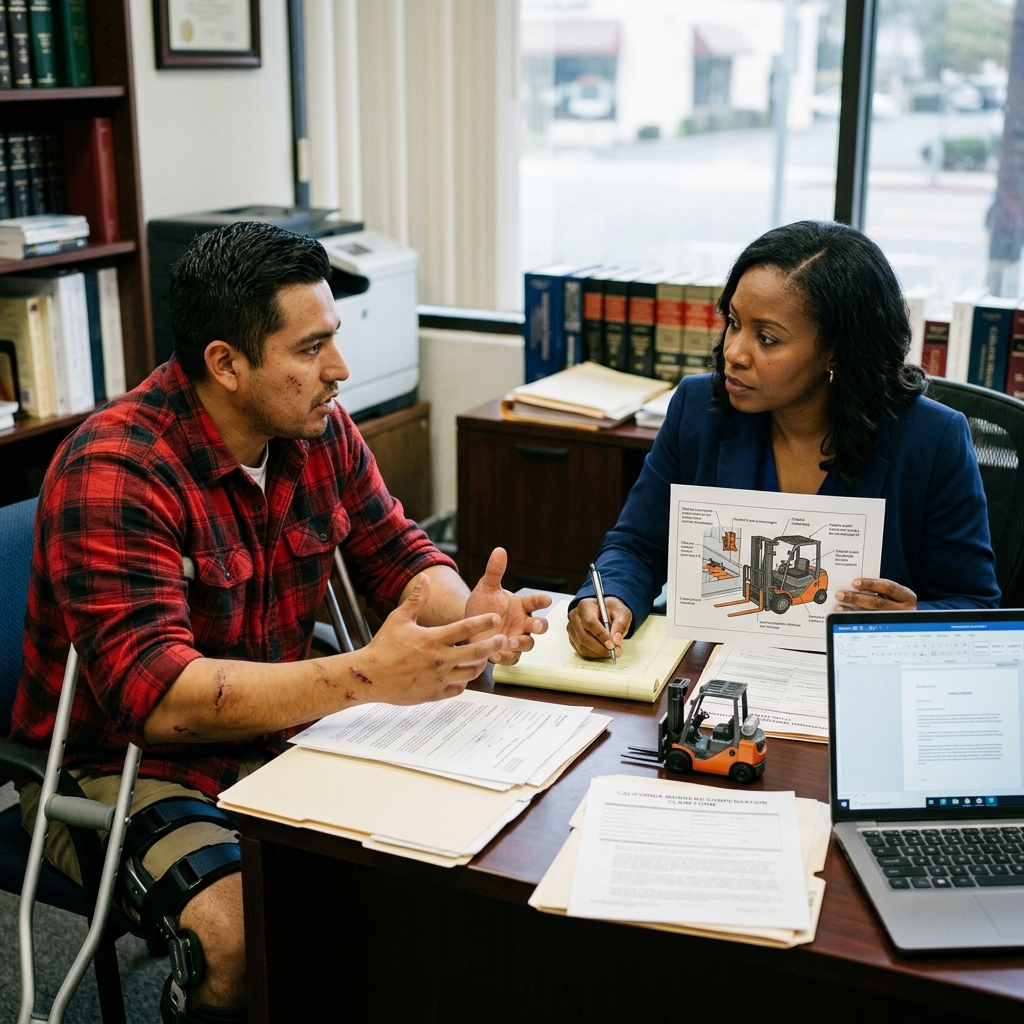
We approach settlement strategically. Early in representation, we don’t reveal our full case strength. We gather complete evidence, retain expert witnesses, and build irrefutable proof of negligence. We then present this evidence to opposing counsel and adjusters, demonstrating that trial will result in verdict far exceeding their settlement offer.
We also prepare for trial from day one. We retain accident reconstruction experts, medical testimony specialists, and vocational rehabilitation experts. We develop clear presentation strategies explaining complex equipment failures or maintenance negligence to jurors. This preparation makes our settlement demands credible, because adjusters know we’ll try your case competently if they reject reasonable offers.
Trial strategy emphasizes human impact. Juries don’t respond to medical terminology or statistical wage loss calculations. They respond to your story: a worker following employer instructions, operating equipment as trained, injured through negligence beyond your control. They understand permanent pain, lost opportunity, and reduced independence. We tell your story through testimony, evidence, and expert explanation.
What to do next: Prepare to discuss your life before and after the injury. How has this accident changed your daily activities, relationships, and future plans? These details personalize your case.
Your Next Steps: Free Consultation With Our Team
If you’ve suffered a forklift accident in California, you’ve already waited long enough. Every day without legal representation increases the risk that critical evidence disappears, witnesses become unavailable, or insurance adjusters cement their position against fair compensation.
We offer free legal consultations with no obligation. You’ll speak with an attorney who understands forklift accident law thoroughly. We’ll review your injury, explain your rights, identify potential defendants, and outline our strategy for maximizing your recovery. You’ll understand exactly what compensation you might receive and how we’ll fight to achieve it.
Our multiple office locations across California mean we’re near you, whether you’re in the Bay Area, Los Angeles, San Diego, or anywhere between. We’ve successfully handled forklift accident cases throughout the state, recovering millions in compensation for injured workers.
Contact California Work Injury Law Center today. Call us for your free consultation, and let’s begin turning your forklift accident claim into the compensation and justice you deserve.
Schedule a Free Consultation Phone Number: 657 605 4418
Frequently Asked Questions (FAQ)
What should I do immediately after a forklift accident at work?
First, prioritize your health and safety by seeking medical attention right away, even if you feel fine initially. Then contact us as soon as possible so we can guide you through the workers’ compensation process and protect your rights. We recommend documenting everything about the incident, including photos, witness names, and details about what happened. Taking these steps quickly helps us build the strongest possible case for your compensation.
How does our no recovery, no fee model work for forklift injury cases?
We only get paid if we successfully recover compensation for you, which means you pay nothing upfront or if we don’t win your case. This arrangement protects you financially while ensuring we’re fully committed to obtaining the maximum benefits and damages you deserve. You can focus on your recovery while we handle the legal complexities without worrying about legal fees draining your resources.
What types of forklift injuries do we typically handle?
We successfully represent injured workers with crush injuries, spinal cord damage, broken bones, traumatic brain injuries, and psychological trauma resulting from forklift accidents. Our team also handles cases involving multiple injuries and long-term complications that affect your ability to work. We understand the unique severity of equipment-related workplace injuries and know how to value your claim appropriately when negotiating with insurance companies and employers.