
Table of Contents
- Why Cumulative Trauma and Retaliation Cases Demand Specialized Legal Expertise
- The Challenges Injured Workers Face in Proving Cumulative Trauma
- Understanding Workplace Retaliation and Your Legal Protections
- Key Criteria for Selecting Your Cumulative Trauma Case Expert
- How We Stand Apart in Cumulative Trauma and Retaliation Representation
- Our Track Record with Complex Psychological and Occupational Injury Claims
- The Contingency Advantage: Why Our No Recovery, No Fee Model Protects You
- Why Multi-Office Representation Across California Matters for Your Case
- Comparing Our Expertise to General Workers Compensation Providers
- Your Free Consultation: The First Step Toward Maximum Compensation
- How We Guide You From Filing to Settlement or Trial Victory
- Frequently Asked Questions (FAQ)
Why Cumulative Trauma and Retaliation Cases Demand Specialized Legal Expertise
Cumulative trauma and retaliation claims represent some of the most complex workers’ compensation battles in California. Unlike a single catastrophic incident, cumulative trauma develops over months or years through repetitive job tasks, environmental exposure, or prolonged stress. Retaliation cases add another layer of complexity because they require proving both the underlying injury claim and the employer’s illegal response to it.
We understand that these cases demand more than general workers’ compensation knowledge. They require deep expertise in how California’s Division of Workers’ Compensation evaluates ongoing harm, psychological injury standards, and the specific legal protections that shield employees from employer retaliation. Without this specialized focus, injured workers often find themselves undercompensated or without recourse when their employer punishes them for filing a claim.
The stakes are substantial. A worker experiencing cumulative trauma from years of construction work or repetitive office tasks may face skepticism from insurers who prefer simpler, single-incident claims. When retaliation enters the picture, workers need advocates who can simultaneously protect their compensation rights and their employment status.
What to do next: Assess whether your injury developed gradually over time or stems from your employer’s response to your claim. Either situation warrants speaking with a specialist rather than settling for generic legal advice.
The Challenges Injured Workers Face in Proving Cumulative Trauma
Proving cumulative trauma requires establishing a clear causal link between your job duties and your medical condition, even when no single event triggered it. Insurers scrutinize these claims heavily because the timeline is longer and causation can feel less obvious than with acute injuries.
Several obstacles commonly derail cumulative trauma claims:
- Medical burden of proof: You need medical evidence showing your condition was caused by work activities, not pre-existing issues or personal factors outside employment.
- Date of injury determination: Identifying the exact date your injury occurred becomes murky when harm accumulated over years. This matters because it affects statute of limitations and benefit calculations.
- Credibility challenges: Insurance adjusters question whether symptoms truly stem from work or are exaggerated by the injured worker.
- Competing medical opinions: Your treating physician may differ from the insurance company’s independent medical examiner about causation and severity.
- Documentation gaps: If you didn’t report symptoms early or lack contemporaneous workplace records, building a strong timeline becomes harder.
We’ve represented countless workers through this frustrating phase. Many arrive at our office believing they have no case because an insurer denied their claim or because they waited to seek medical treatment. The truth is more nuanced. California law recognizes cumulative trauma even when the injury developed silently over an extended period. The key is building a narrative that connects your specific job activities to your documented medical condition.
Understanding the date of cumulative trauma is critical because it influences everything from benefit calculations to the statute of limitations for filing. This determination often becomes a point of dispute that requires expert analysis.
Your actionable step: Gather any workplace records, medical notes, and timelines of when symptoms first appeared. Even rough documentation helps us build a compelling causation narrative.
Understanding Workplace Retaliation and Your Legal Protections
California law strictly prohibits employer retaliation against workers who file compensation claims, report unsafe conditions, or cooperate with investigations. Yet retaliation remains one of the most common violations we encounter, often disguised as performance issues or legitimate business decisions.
Retaliation can take many forms. An employer might suddenly discipline you for minor infractions, cut your hours, reassign you to undesirable positions, deny promotions, or manufacture reasons to terminate you. The illegal element isn’t the action itself but rather the retaliatory motive.
Here’s what separates a legal employment decision from illegal retaliation: timing and pattern. If your employer took adverse action within days or weeks of your workers’ compensation filing, that proximity suggests retaliation. If you had no prior performance issues and suddenly received negative evaluations after filing a claim, that inconsistency supports a retaliation case.
California Labor Code Section 132a makes clear that employees cannot be terminated or suffer any adverse employment action because they filed or pursued a workers’ compensation claim. This protection extends beyond just the filing itself. It covers injuries reported, medical treatment, cooperation with claims investigations, and even the act of seeking legal representation.
We pursue retaliation claims as aggressively as the underlying injury claim because they often go hand in hand. A worker suffering cumulative trauma and facing retaliation needs comprehensive legal protection on both fronts.
Immediate action: Document any negative employment actions taken after your compensation claim, including dates, witnesses, and how these actions differ from your normal work experience.

Key Criteria for Selecting Your Cumulative Trauma Case Expert
When evaluating attorneys for your cumulative trauma and retaliation case, look beyond general workers’ compensation credentials. The right expert should demonstrate several key strengths.
First, verify their specialized experience. Ask how many cumulative trauma cases they’ve handled and what percentage of their practice focuses on these claims. General workers’ comp attorneys handle thousands of straightforward injury cases yearly, but that volume doesn’t translate to cumulative trauma expertise. You want someone who has spent considerable time understanding the nuanced medical and legal standards specific to these claims.
Second, examine their track record with psychological and occupational injuries. Psychological injury cases follow different rules than physical injuries and require distinct medical evidence. An attorney experienced with both strengthens your position.
Third, confirm they maintain an independent contingency model. If your lawyer’s income depends on the insurance company or employer goodwill, their incentives misalign with maximizing your recovery. We operate on a no recovery, no fee basis, meaning we’re invested in your success because we only earn when you do.
Fourth, evaluate their litigation capability. Not every cumulative trauma claim settles. Some require trial testimony and vigorous advocacy. Choose an attorney prepared to take your case all the way if settlement negotiations stall.
Finally, assess communication and accessibility. Your attorney should explain complex legal concepts clearly and remain available during your claim process. Multiple office locations across California signal that the firm prioritizes accessibility for clients statewide.
Next step: Request a free consultation and ask specific questions about their cumulative trauma experience, recent case outcomes, and how they handle retaliation simultaneously with injury claims.
How We Stand Apart in Cumulative Trauma and Retaliation Representation
We’ve built our practice around the cases that general workers’ comp lawyers often defer or mishandle. Cumulative trauma and retaliation claims form the backbone of our representation because they demand the kind of specialized focus we provide daily.
Our distinction rests on several pillars. We dedicate substantial resources to understanding the evolving medical literature on occupational injuries, psychological trauma, and cumulative harm. We maintain ongoing relationships with medical experts who can testify credibly about causation in complex scenarios. We track appellate decisions that shape cumulative trauma law to stay ahead of legal changes that benefit our clients.
We refuse to treat your claim as a transaction. Instead, we develop comprehensive theories of your case that address both the injury itself and any employer retaliation that follows. Many workers experience retaliation precisely because they filed a claim, and we pursue both claims in tandem rather than abandoning one to focus on the other.
We also operate independently. We don’t partner with insurance companies, employers, or third-party administrators that might pressure us to settle quickly or undervalue your claim. Our no recovery, no fee model aligns our success directly with maximizing your compensation.
Our multi-office presence across California means you access the same level of expertise whether you’re in San Francisco, Los Angeles, or the Central Valley. We’ve represented construction workers, healthcare professionals, teachers, and office workers through cumulative trauma claims that would have failed without specialized advocacy.
What this means for you: You get attorneys who wake up thinking about cumulative trauma strategy, not lawyers who handle your case as one of a thousand similar matters.
Our Track Record with Complex Psychological and Occupational Injury Claims
Numbers tell part of our story, but outcomes demonstrate it fully. We’ve secured substantial settlements and trial verdicts for workers facing cumulative trauma combined with workplace retaliation. Many arrived believing their cases were hopeless after initial denials or unfavorable medical evaluations.
One consistent theme across our cases involves psychological trauma layered with physical injury. A healthcare worker suffers years of patient violence and heavy lifting, developing both psychological injury and cumulative musculoskeletal damage. An administrative employee endures years of discriminatory treatment alongside repetitive strain, generating a combined claim. These intersecting harms require medical evidence, legal strategy, and litigation readiness that general practitioners struggle to coordinate.
We’ve convinced independent medical examiners to acknowledge causation in cases where insurance-retained doctors initially disputed the injury. This typically happens through rigorous preparation, compelling medical history documentation, and expert testimony that stands up to cross-examination.
We’ve also obtained retaliation settlements for workers who faced immediate termination after filing cumulative trauma claims. The pattern and timing evidence, combined with documentation of the adverse employment actions, often persuades employers to settle rather than litigate retaliation alongside the underlying injury claim.
Our success rate reflects the quality of preparation we invest before trial. Most cases settle favorably because we demonstrate to opposing counsel that we’ve built an undeniable case. When settlement negotiations stall, our litigation readiness compels serious negotiation.
Take-away: Our experience with these complex intersecting claims means we see pathways to compensation that general attorneys miss.

The Contingency Advantage: Why Our No Recovery, No Fee Model Protects You
The way we charge matters more than you might initially realize. We operate on a contingency basis, which means you pay nothing unless we recover compensation for you. This model protects injured workers in ways hourly billing and other fee structures simply cannot.
Under hourly billing, your legal costs mount regardless of outcome. If you lack resources to pay ongoing attorney fees while your case develops, you may abandon a meritorious claim. Some attorneys require retainers upfront, creating barriers for injured workers already financially stressed by lost wages and medical expenses. We eliminate this barrier entirely.
Our contingency model also aligns our financial incentives with yours perfectly. We only succeed when you succeed. We don’t benefit from quick settlements that undervalue your claim or prolonged litigation that runs up our billable hours. Instead, we’re motivated to pursue the maximum reasonable recovery as efficiently as possible.
This structure proves especially valuable for cumulative trauma and retaliation cases because they require significant preparation and expert involvement. Medical evaluations, expert testimony, and legal research into causation and retaliation standards cost real money. Under hourly billing, those costs would accrue to you. Under our contingency model, we absorb those costs and recover them from your settlement or verdict.
We’ve found that clients who don’t worry about hourly billing communicate more freely, cooperate more completely, and feel genuinely partnered with their attorney. That openness and collaboration strengthens case strategy and often leads to better outcomes.
Your protection: You face zero financial risk. If we don’t recover compensation, you owe us nothing. Your only responsibility is cooperating with our investigation and following our legal advice.
Why Multi-Office Representation Across California Matters for Your Case
We maintain multiple office locations throughout California because cumulative trauma and retaliation cases require local knowledge and accessibility. An injured worker in San Diego deserves the same specialized expertise as someone in Oakland, and geography shouldn’t determine quality representation.
Our distributed presence provides practical advantages. You can meet with your attorney locally rather than traveling to distant offices. Our teams across California understand regional workplace dynamics, industry standards for specific areas, and local judges’ tendencies. A construction worker’s cumulative trauma case in the Central Valley involves different industry practices than the same claim in Silicon Valley.
We maintain consistent case strategy across all offices while tailoring approaches to local contexts. This means you benefit from firm-wide expertise while receiving representation adapted to your specific location and industry.
Local presence also enables faster investigation and evidence gathering. We can interview witnesses, review workplace conditions, and obtain records without geographic delays. This responsiveness matters when building cumulative trauma cases that depend on detailed documentation.
Our multi-office infrastructure also demonstrates stability and commitment. We’ve invested substantially in serving California workers throughout the state, not just concentrating in profitable urban centers. This commitment translates to reliable advocacy regardless of where your injury occurred.
Practical benefit: You access specialized expertise nearby, eliminating travel burdens while maintaining the quality you need for a complex claim.
Comparing Our Expertise to General Workers Compensation Providers
General workers’ compensation attorneys handle high-volume practices that reward speed and efficiency. They might resolve hundreds of cases yearly through quick settlements on straightforward injury claims. That model works for single-incident injuries with clear causation and minimal disputes.
Cumulative trauma and retaliation cases operate differently. They require extended development periods, medical expert coordination, detailed causation analysis, and often litigation readiness. General practitioners frequently underprice these cases because they underestimate the complexity or misunderstand the legal standards specific to cumulative harm.
We’ve seen injured workers represented by general attorneys accept settlements worth 30 to 50 percent below appropriate value. This happens because general practitioners lack the specialized knowledge to build compelling cumulative trauma narratives or properly value the long-term disability impact.
Retaliation claims compound this problem. Many general attorneys treat retaliation as secondary to the injury claim, sometimes abandoning it entirely when it complicates settlement negotiations. We view retaliation claims as equally important and pursue them with the same vigor as the underlying injury.
Our specialized focus means we understand the evolving case law specific to cumulative trauma, know which medical professionals provide credible expert testimony, and maintain litigation strategies tailored to these complex cases. We also stay current with how judges and workers’ compensation judges evaluate psychological injury evidence, a critical advantage in many modern cumulative trauma claims.
The comparison: Choose specialized representation for specialized claims. General practitioners excel at high-volume, straightforward cases. Cumulative trauma and retaliation demands more.
Your Free Consultation: The First Step Toward Maximum Compensation
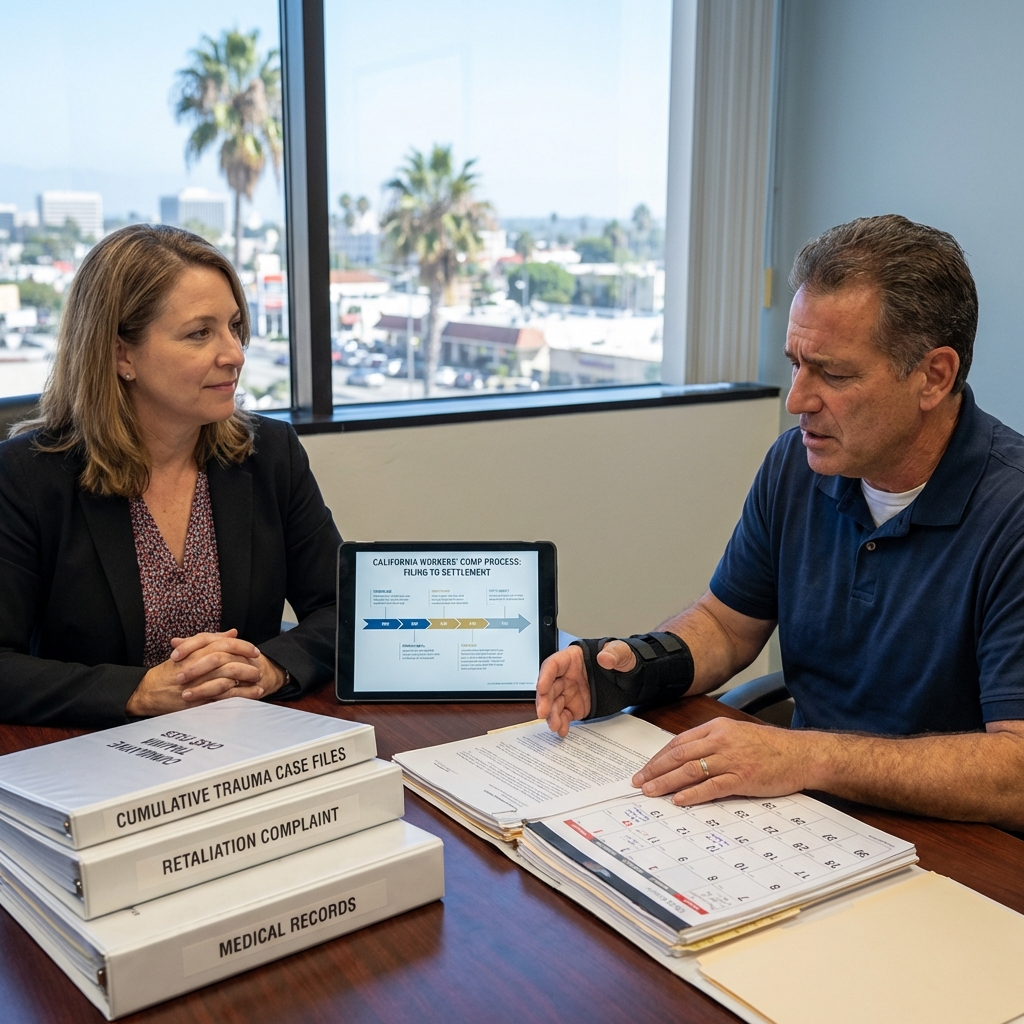
We offer free legal consultations specifically because injured workers shouldn’t have to pay to learn whether they have a viable claim. You’ll speak with an experienced attorney who specializes in cumulative trauma and retaliation cases, not an intake coordinator or legal assistant.
During your consultation, we ask detailed questions about your job duties, timeline of symptom development, medical treatment history, and any employer actions taken after your claim. We explain our assessment of your claim’s strength, the likely compensation range, and our recommended path forward. We answer your questions candidly and discuss what success might look like in your specific situation.
This conversation serves multiple purposes. It gives you essential information to decide whether pursuing your claim makes sense. It allows us to evaluate whether we’re the right fit for your case. And it creates an opportunity for you to assess our expertise and communication style before committing to representation.
Many injured workers arrive at our consultation believing they have no case. After we explain cumulative trauma standards, discuss retaliation protections, and review their specific facts, they realize they have viable claims worth pursuing. We’ve seen workers recover six and seven-figure settlements they initially thought impossible.
Schedule now: Contact us for a free consultation. Bring any workplace records, medical documentation, and details about employer actions after your claim filing. The conversation costs nothing, but it might clarify your path forward significantly.
How We Guide You From Filing to Settlement or Trial Victory
Once you retain our representation, we manage your claim through every stage. Our process balances efficiency with thoroughness, moving your case forward while building the strongest possible record.
We begin by filing your official workers’ compensation claim with all necessary documentation. We gather your complete medical history, obtain records from your treating physicians, and sometimes arrange independent medical evaluations to strengthen our causation evidence. We document any retaliation or adverse employment actions in a comprehensive timeline.
We then communicate with the insurance company, presenting our case theory and initial demand. For many claims, this early negotiation phase leads to favorable settlement discussions. We maintain ongoing dialogue with opposing counsel, providing additional evidence and expert analysis that demonstrates your claim’s strength.
For claims that don’t settle early, we prepare for litigation. This means gathering trial evidence, preparing medical witnesses for deposition and testimony, developing legal arguments specific to cumulative trauma standards, and organizing all documentation for potential hearing before a workers’ compensation judge.
Throughout this process, we keep you informed. You understand what we’re doing, why we’re doing it, and what outcomes we anticipate. We explain legal concepts clearly and help you make informed decisions about settlement offers or trial strategy.
We pursue maximum compensation through whatever path achieves that goal. Sometimes that’s a negotiated settlement. Sometimes it’s litigation. We’re prepared for either scenario and recommend the approach most likely to serve your interests.
The bottom line: You don’t manage your claim alone. We coordinate every element, from filing through settlement or trial, ensuring nothing falls through the cracks and your compensation reflects the true value of your case.
We’ve built California Work Injury Law Center around injured workers facing cumulative trauma and retaliation claims that demand specialized expertise. Our focus, independence, contingency model, and multi-office presence across California make us the definitive choice for workers needing maximum compensation and comprehensive legal protection. If you’re experiencing cumulative trauma, facing retaliation, or both, contact us for your free consultation and learn why thousands of California workers have chosen our specialized advocacy.
Schedule a Free Consultation Phone Number: 657 605 4418
Frequently Asked Questions (FAQ)
How do we prove cumulative trauma claims in California?
We build cumulative trauma cases by documenting repeated workplace exposures or incidents over time that collectively caused your injury. Our approach involves gathering medical evidence, employment records, and expert testimony to establish the direct connection between your work activities and the resulting condition. We work with occupational health specialists to demonstrate how the gradual nature of your exposure distinguishes your claim from a single-incident injury.
What makes workplace retaliation cases different from standard workers compensation claims?
Retaliation cases require us to prove that your employer took adverse action against you because you filed a workers compensation claim or reported unsafe conditions. We investigate the timeline of events, communications, and employment decisions to establish the causal link between your protected activity and the retaliation. These claims often involve additional remedies beyond workers compensation benefits, including damages for lost wages and emotional distress.
Why does our no recovery, no fee model benefit injured workers?
We only get paid when you receive compensation, which means our financial interests align completely with yours. You face no upfront costs or hourly billing risks, allowing you to pursue your claim without worrying about legal expenses mounting during the process. This arrangement removes the financial barriers that many injured workers face when seeking specialized legal representation.