
Table of Contents
- Understanding Wrongful Termination in Construction: Why Your Case Matters
- Identifying Illegal Retaliation After Workplace Injuries
- Documenting Evidence That Strengthens Your Wrongful Termination Claim
- Navigating California Labor Laws: Your Strongest Protections
- Proving Causation Between Injury Report and Termination
- Maximizing Damages in Construction Site Wrongful Termination Cases
- Why Specialized Construction Injury Representation Makes the Difference
- Frequently Asked Questions (FAQ)
Understanding Wrongful Termination in Construction: Why Your Case Matters
Construction workers in California face a unique vulnerability. You’re injured on the job, you report it, and weeks later you’re terminated. Was it coincidence, or was it retaliation? We’ve represented hundreds of injured construction workers who found themselves in exactly this position, and we’ve learned that the line between legal and illegal termination is clearer than many employers hope you’ll believe.
Wrongful termination claims in construction are distinct from standard employment disputes. The injury itself complicates everything. Your employer may claim the termination was performance-related or due to schedule changes, but the timing tells a different story. That’s where our specialized approach makes the difference. We know how to connect the dots, document the pattern, and hold contractors and construction companies accountable.
Wrongful termination in construction happens when an employer fires you in violation of California law, particularly in retaliation for reporting a workplace injury or workers’ compensation claim. This isn’t just about losing your job. It’s about your employer punishing you for exercising your legal right to report an injury and seek medical care.
Why does your case matter? Because construction is a high-injury industry, and some employers operate with the assumption that injured workers won’t fight back. They count on you being too focused on recovery, too financially desperate, or too intimidated to hire an attorney. When you stand up for yourself, you’re not just protecting your own income. You’re setting a standard across the entire California construction industry that retaliation won’t be tolerated.
California law gives you powerful protections here. You cannot be fired, demoted, reduced in hours, or otherwise retaliated against because you reported a workplace injury, filed a workers’ compensation claim, or cooperated with an insurance investigation. The law treats this retaliation as wrongful termination, a separate claim from your workers’ compensation benefits.
The financial stakes are substantial. A wrongful termination claim can recover lost wages, emotional distress damages, punitive damages if your employer acted with fraud or malice, and attorney fees. This is different from your workers’ compensation claim, which covers only medical expenses and disability benefits but provides no recovery for the intentional harm of losing your job.
What to do next: If you’ve been terminated within 30 days of reporting an injury, document the timing immediately. Write down the exact dates you reported the injury and when you were fired, along with any witnesses.
Identifying Illegal Retaliation After Workplace Injuries
Not every termination after an injury is illegal retaliation. Your employer can fire you for legitimate, non-retaliatory reasons. The challenge is proving the timing and circumstances create a rebuttable presumption of retaliation.
We look for several patterns that signal illegal retaliation:
- Your termination occurred shortly after reporting the injury (typically within 30 days, but sometimes longer)
- Your employer’s stated reason for termination contradicts how they’ve treated similar situations with uninjured employees
- Your performance ratings dropped suddenly after the injury, despite prior positive evaluations
- Your employer made negative comments about your injury or workers’ compensation claim before firing you
- You were the only employee terminated during a particular time period or the only injured worker let go
One of our recent clients, a skilled ironworker, reported a serious back injury after a fall. His supervisor told him to “toughen up” and get back on the job. When he insisted on seeing a doctor and filed a workers’ compensation claim, the company claimed they were eliminating his position due to a slow job site. However, we discovered they hired a replacement at the same wage within two weeks. That’s retaliation, and the evidence was clear.
The key is comparative evidence. We examine how your employer has treated other employees in similar circumstances. Did they fire other workers for the same stated reasons, or were you singled out? This comparative analysis often reveals the true motivation.
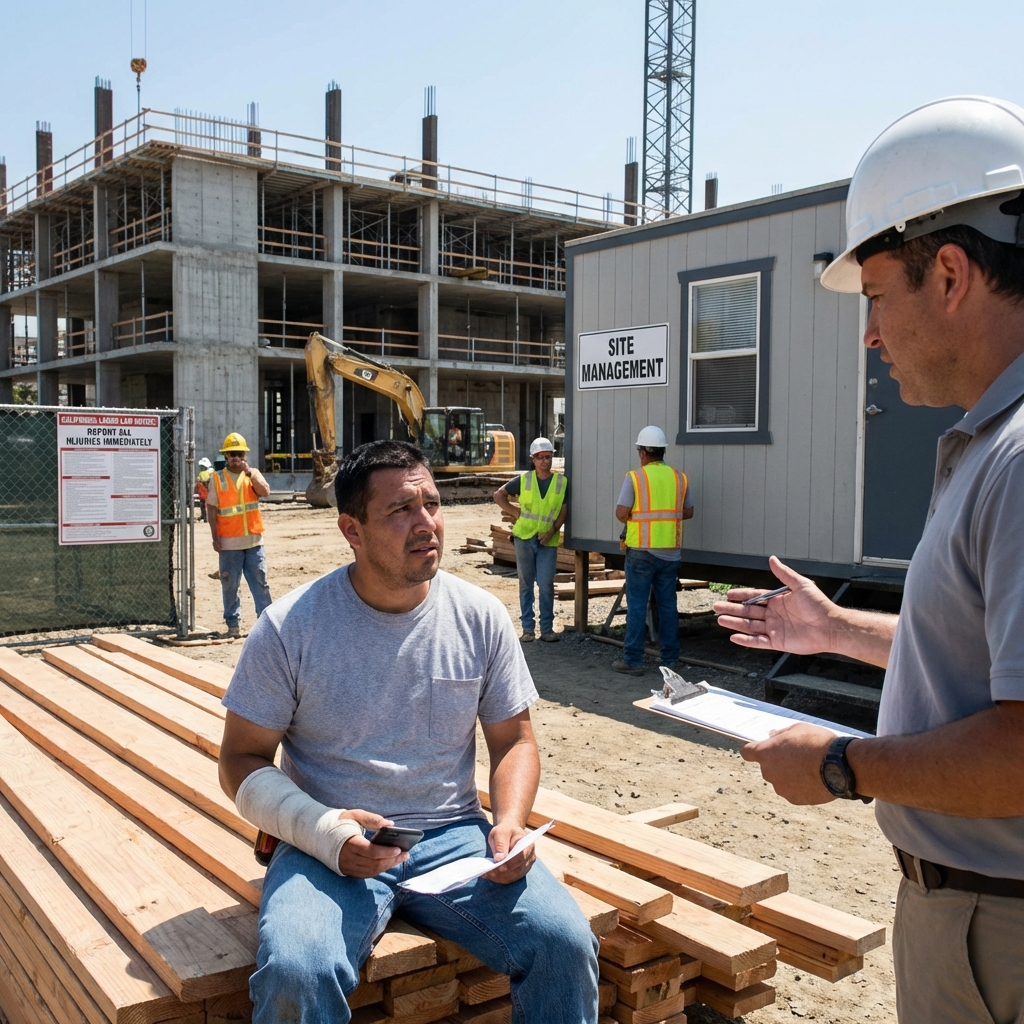
What to do next: Before or immediately after termination, gather performance reviews, email communications, and any written notes about your interactions with supervisors. These documents become your roadmap for proving differential treatment.
Documenting Evidence That Strengthens Your Wrongful Termination Claim
Documentation wins cases. We cannot overstate this. The difference between a weak claim and a winning one often comes down to what you preserved immediately after the injury and termination.
Start by creating a detailed timeline. Record the exact date you reported the injury, who you reported it to, what you said, and who witnessed it. Include any written communications: emails, text messages, safety reports, or workers’ compensation forms. Preserve your employee file if you can access it, including performance reviews, disciplinary records, and attendance logs.
Next, document the termination itself. What was the stated reason? Get it in writing if possible. Ask your employer for written clarification of the termination reason. Record their response word-for-word. If they gave you an exit interview, request a copy.
Medical records matter too, but in a different way. Your injury documentation establishes that you were injured and made a legitimate claim. It shows the timeline and severity. However, your wrongful termination claim stands independently. We’ve won cases where the injury was minor but the retaliation was obvious.
Witness statements carry significant weight. Any coworker who heard about your injury report, saw the termination letter, or heard comments from management about your claim is a potential witness. Get their contact information and notes about what they know. We can follow up with formal statements later.
Communication records deserve special attention. If your employer sent you notices about the termination, kept them all. If you responded to the termination or requested clarification, preserve those messages. If HR involved themselves in the decision, any emails or memos they generated are discoverable.
What to do next: Create a physical or digital file today. Scan all documents related to your injury and termination. If you have emails, export them to a safe location. Screenshot text messages and instant messages before they disappear.
Navigating California Labor Laws: Your Strongest Protections
California’s California labor laws create a fortress of protection for injured workers. We leverage these statutes in every wrongful termination case we handle.
Labor Code Section 6310 is your foundational protection. It explicitly prohibits employers from discharging or discriminating against employees who report occupational safety violations or hazardous conditions. If you reported an unsafe condition that caused your injury, this statute applies directly.
Labor Code Section 132(a) is equally powerful. It makes retaliation illegal when an employee files a workers’ compensation claim, reports an injury, or cooperates with workers’ compensation proceedings. This protection applies even if the injury wasn’t reported to Cal/OSHA; simple filing of a workers’ compensation claim triggers the statute’s protection.
California also recognizes a broader wrongful termination in violation of public policy. Even if a specific statute doesn’t apply, you cannot be fired for exercising a fundamental public right. Seeking medical care for a work injury is a public right, making retaliation illegal.
The burden of proof mechanics matter strategically. If termination occurs within 30 days of an injury report, California presumes retaliation. Your employer then bears the burden of proving the termination was for a legitimate, independent reason. After 30 days, the burden shifts to you, though timing still suggests retaliation.
We also examine the interaction between workers’ compensation and wrongful termination law. Your workers’ compensation claim cannot include lost wages from wrongful termination. That’s why you need a separate wrongful termination claim. However, the workers’ compensation process often generates evidence useful in proving retaliation: the injury report, the employer’s response, any communications about your claim status.
What to do next: If you haven’t already, file your workers' compensation claim immediately. This filing date becomes critical evidence in a wrongful termination case.

Proving Causation Between Injury Report and Termination
Causation is the bridge between the injury and the termination. You must prove the termination wouldn’t have happened but for your injury report or workers’ compensation claim. This is where the temporal proximity we mentioned earlier becomes powerful evidence.
Courts recognize that the closer the termination follows the injury report, the stronger the inference of retaliation. A termination two days after reporting an injury raises obvious questions. A termination a month later requires stronger corroborating evidence, but the presumption still applies within 30 days.
We build causation through circumstantial evidence because direct evidence is rare. Employers almost never write “we’re firing you because you reported an injury.” Instead, we compile a mosaic of facts: the timing, the pretextual reason, the treatment of similarly situated employees, prior positive evaluations that suddenly became negative, comments about the injury or claim.
One effective strategy involves examining the decision-makers. Who decided to terminate you? What was their knowledge of the injury report? What communications did they receive about your claim? We often find that the person who made the termination decision knew about the workers’ compensation claim but the company’s defense relies on a story that ignores this knowledge.
We also investigate whether the stated reason for termination is pretextual. If your employer claims you were fired for attendance, we examine whether other employees with worse attendance remained employed. If they claim poor performance, we pull performance evaluations to show your prior record. Pretext weakens the employer’s defense and strengthens our causation argument.
What to do next: Gather evidence of your work performance before the injury. Any positive emails, completion certificates, safety awards, or promotion discussions support your case by showing you were a valued employee before the injury.
Maximizing Damages in Construction Site Wrongful Termination Cases
The financial recovery in wrongful termination cases extends beyond base wages. We structure damages claims to capture the full impact of the retaliation.
Lost wages form the foundation. This includes all wages you would have earned from the termination date through the date you secured equivalent employment, or for a reasonable period if replacement employment wasn’t available. For construction workers, seasonal variation matters. If you were terminated during high-work season, the lost wages may be substantial.
Front pay represents an alternative to lost wages when reinstatement isn’t practical or desired. We calculate what you would have earned through trial if reinstatement occurred, providing a lump sum award.
Emotional distress damages are available when the employer’s conduct was extreme and outrageous. Construction workers often experience significant emotional harm from being terminated after an injury: stress about medical bills, mortgage payments, loss of identity tied to their trade. We document this through medical records, testimony, and sometimes mental health evaluations.
Punitive damages are available if we prove fraud or malice. This applies when the employer knowingly violated the law or acted with reckless disregard. If your employer had a pattern of retaliating against injured workers, or if management deliberately misrepresented the reason for termination, punitive damages become available.
We also recover attorney fees and costs. California law requires employers who retaliate against injured workers to pay the attorney fees of the prevailing employee. This removes the financial barrier to litigation and aligns our interests with yours.
Prejudgment interest runs from the termination date through judgment. Though often overlooked, this adds meaningful value to settlements and verdicts.
What to do next: Calculate your lost wages carefully, including benefits, overtime, and bonuses you would have received. Provide us with tax returns or W-2s covering the two years before termination.
Why Specialized Construction Injury Representation Makes the Difference
We represent injured construction workers as our core practice. This isn’t a side service we offer. It’s our entire focus, and it shows in the results we achieve.
Construction industry expertise matters profoundly. We understand prevailing wage requirements, the subcontractor relationships that complicate injury claims, the seasonal employment patterns that affect damages, and the specific hazards of different trades. A general employment attorney may understand California employment law broadly, but they won’t understand the construction industry specifics that drive your case.
We’ve built relationships with construction safety experts, occupational health physicians, and economists who calculate damages in construction cases. When we need to prove your injury was foreseeable or that your employer violated industry standards, we have specialists ready to testify. These experts carry weight in settlement negotiations and at trial.
Our contingency model aligns our interests with yours completely. We recover no fee unless we recover compensation for you. This means we invest fully in your case without you bearing upfront legal costs. We take on the risk because we’re confident in our approach and our track record.
We maintain multiple office locations across California, allowing us to serve injured workers throughout the state. Whether you’re in Los Angeles, the Central Valley, Northern California, or San Diego, we have local representation and deep understanding of regional construction practices.
Our free legal consultations let you evaluate your case before committing to representation. We’ll review your circumstances, explain the law, and tell you honestly whether wrongful termination applies to your situation. If we believe we can help, we’ll outline our strategy and timeline.
We’ve recovered millions for injured construction workers facing wrongful termination. These victories aren’t abstract statistics. They represent workers who stood up for themselves and received the compensation they deserved. When construction companies understand that injuring workers and then firing them will result in litigation and meaningful damages, the industry improves for everyone.
If you’ve been terminated after reporting a workplace injury, contact us today. Your case deserves representation from attorneys who specialize in construction injury law and understand both the legal issues and the human impact of retaliation. We’ll fight to restore your compensation and your reputation.
Schedule a Free Consultation Phone Number: 657 605 4418
Frequently Asked Questions (FAQ)
What protections do I have if I’m terminated after reporting a workplace injury in California?
We help our clients understand that California law explicitly protects workers from retaliation when they report injuries or file workers’ compensation claims. If your employer fires you, demotes you, or reduces your hours within a certain timeframe after an injury report, we can argue this constitutes illegal retaliation. Our role is to gather documentation showing the connection between your injury report and termination, which strengthens your claim for both wrongful termination and additional damages.
How do we prove that my construction site injury led to wrongful termination?
We establish causation by collecting evidence showing the timeline between your injury, your report to management, and your termination or adverse employment action. This includes witness statements, medical records, email communications, and your employment records. Our construction-focused legal team knows the specific patterns and practices in the industry, allowing us to identify when timing and circumstances point clearly to retaliation rather than legitimate business reasons.
What compensation can we recover in a wrongful termination case after a construction injury?
We pursue damages that include lost wages, benefits you lost due to termination, emotional distress, and in some cases punitive damages when we can demonstrate willful misconduct by your employer. Beyond your wrongful termination claim, we also ensure you receive your full workers’ compensation benefits for the original injury, which many construction workers miss when they don’t have experienced representation.