
Table of Contents
- Why Repetitive Stress Claims Get Denied
- Understanding Your Appeal Rights in California
- How We Build Stronger Evidence for Your Case
- Medical Documentation Strategies That Win Appeals
- Proving Causation for Cumulative Trauma Injuries
- Our Proven Appeal Success Process
- What to Expect During the Appeals Phase
- Common Mistakes That Weaken Your Claim
- Your Path Forward With Our Legal Team
- Frequently Asked Questions (FAQ)
Why Repetitive Stress Claims Get Denied
A denied repetitive stress injury claim feels like a betrayal. You’ve developed carpal tunnel, tendonitis, or back pain from years of workplace tasks. Your employer’s insurance carrier rejected your workers’ compensation claim. Now you’re facing medical bills and lost wages with no clear path forward.
We handle these denials regularly at California Work Injury Law Center, and we want you to know: denial is not the end. In fact, most denied repetitive stress claims can be successfully appealed when you have the right evidence and legal strategy behind you.
Insurance companies deny repetitive stress injury claims at higher rates than acute injuries because cumulative trauma is harder to prove. Unlike a single fall or machinery accident with immediate witnesses, repetitive stress develops gradually. This complexity gives insurers room to argue that your condition came from non-work sources.
The most common denial reasons we see include:
- Insufficient medical documentation linking your job duties to your specific injury
- Lack of clear causation evidence between your work tasks and your condition
- Claims that your injury resulted from pre-existing conditions or personal activities
- Missing timeline documentation showing when symptoms began
- Medical records that don’t explicitly state the injury is work-related
Insurers also deny claims when employees haven’t properly reported the injury through official channels or when there’s a gap between when the condition developed and when it was formally documented. We’ve found that insurers often interpret ambiguity in medical records in their favor, not yours.
Your job now is to remove that ambiguity by building an airtight appeal backed by medical evidence and legal expertise.
Understanding Your Appeal Rights in California
California’s workers’ compensation system gives you strong appeal rights when an insurer denies your claim. You are not powerless, and there are multiple levels where your case can be reviewed.
Your first appeal option is an informal conference with the claims examiner. This happens at the Division of Workers’ Compensation and allows you to present new evidence or arguments without formal proceedings. Many claims are overturned at this stage if you introduce compelling medical documentation or expert testimony.
If the informal conference doesn’t resolve your case, you can request a formal hearing before a workers’ compensation judge. This is where your case gets the full legal treatment. You can present medical evidence, expert witnesses, and testimony about how your job duties caused your injury. The judge makes a binding decision based on the evidence presented.
Throughout both stages, you have the right to have an attorney represent you. Under California’s contingency fee model, we only get paid if you win, which means we have every incentive to build the strongest possible case.
How We Build Stronger Evidence for Your Case

Our approach starts with a complete reassessment of your medical history and job duties. Many denied claims lack critical connection points between what you did at work and what happened to your body.
We work with independent medical examiners who specialize in occupational injuries and cumulative trauma. These doctors can review your work activities, your medical records, and your current condition to provide detailed causation opinions. Insurance-selected doctors often downplay work-relatedness; independent medical experts give you a fair analysis that can become powerful courtroom evidence.
We also reconstruct your job duties in detail. We visit worksites when possible, interview coworkers about repetitive tasks, and gather job descriptions from your employer. This documentation shows the appeals judge exactly what movements, forces, and frequencies your body endured over time.
Additionally, we search for any previous medical records showing early symptoms that your current claim may have overlooked. Sometimes you complained of wrist pain to your regular doctor years before filing a workers’ comp claim. That early documentation becomes valuable proof that your condition originated from work, not from recent personal activities.
Medical Documentation Strategies That Win Appeals
The difference between a denied claim and an approved appeal often comes down to how well your medical records tell your story.
We work with your treating physicians to ensure their reports explicitly connect your job duties to your diagnosis. Many doctors document the injury but don’t clearly state it’s work-related. We provide physicians with specific language and job duty descriptions so their reports become stronger legal evidence.
We also help you obtain functional capacity evaluations (FCE) that measure your actual physical limitations. An FCE shows exactly what repetitive motions, gripping forces, or positioning your body cannot tolerate. When that FCE matches your job duties perfectly, it becomes nearly impossible for an insurer to argue your injury is unrelated to work.
Timeline documentation is equally critical. We help you establish when you first noticed symptoms, when you reported them to your supervisor, and when you first sought medical treatment. A clear timeline demonstrates that your condition developed progressively from work activities, not suddenly from something unrelated.
For proving repetitive stress injuries, we also request imaging studies, nerve conduction tests, and electromyography when appropriate. These objective medical tests provide hard evidence that your injury is real and measurable, which strengthens your appeal significantly.
Proving Causation for Cumulative Trauma Injuries
Causation is where repetitive stress claims live or die. You must prove that your job duties caused your injury, not that you happened to develop an injury while employed.
California law requires that work be a “substantial factor” in causing your injury. This doesn’t mean work was the only cause; it means work meaningfully contributed to your condition. For repetitive stress injuries, we establish causation through several evidence types working together.
Occupational medicine experts are invaluable here. They understand how specific job tasks create biomechanical stress on specific body parts. An expert can testify that performing assembly line work for eight hours daily, using forceful gripping and repetitive wrist motions, substantially contributed to your carpal tunnel syndrome.
We also look at epidemiological evidence. If scientific literature shows that workers performing your exact job duties have higher rates of your specific injury, that helps prove work-relatedness. Your condition isn’t rare or unusual for someone in your position.
Comparative analysis also matters. We examine whether non-work activities could reasonably explain your injury. If you’re not a musician, competitive athlete, or hobbyist engaging in repetitive motions outside work, that strengthens the argument that your job caused the injury.
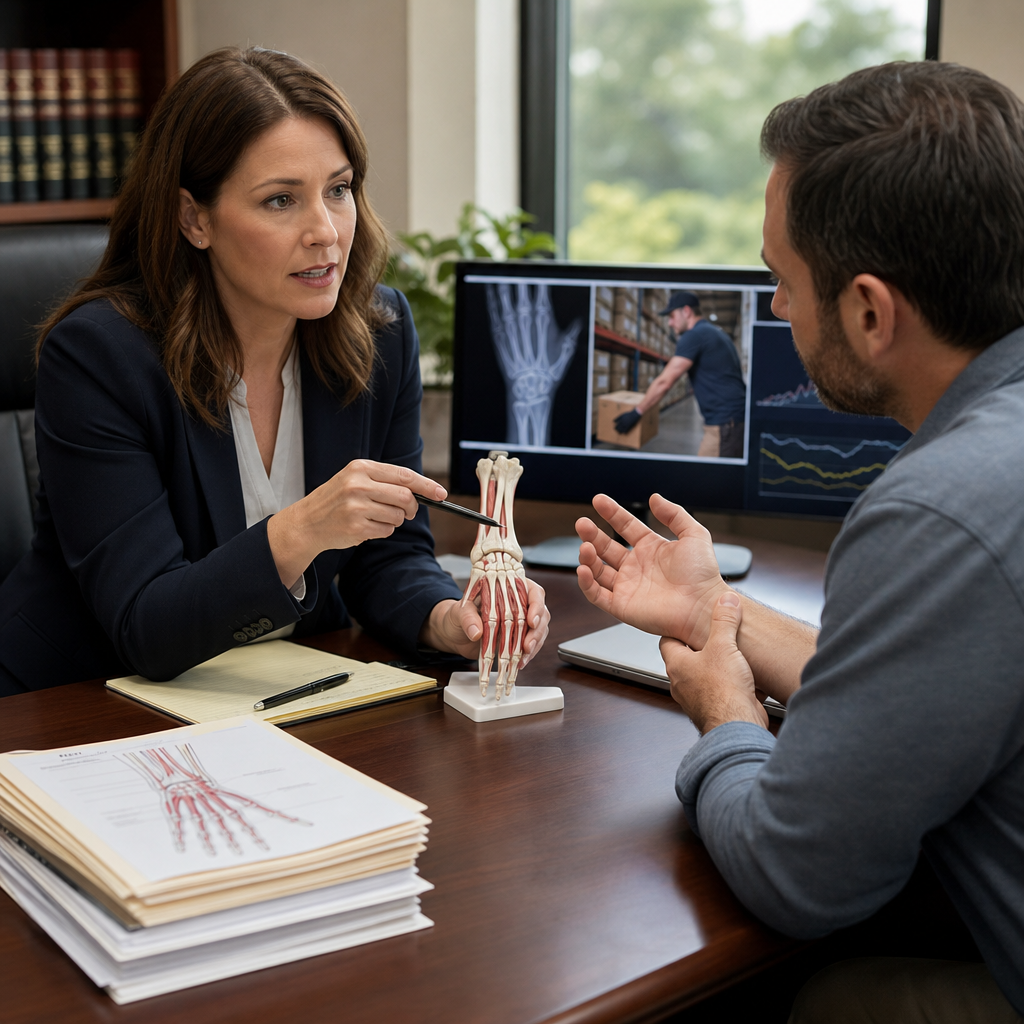
For medical evidence for cumulative trauma, we compile peer-reviewed studies, occupational health data, and expert opinions into a comprehensive causation package that’s difficult for insurers to refute.
Our Proven Appeal Success Process
We follow a structured approach when appealing your denied repetitive stress claim.
First, we conduct a free legal consultation where we review your entire file. We identify which denials have strong appeal potential and which require additional medical evidence before we proceed.
Next, we file a Request for Expedited Hearing or Reconsideration with supporting documentation. This formal request triggers the appeals process and gives us the opportunity to present new evidence the original claims examiner may have overlooked.
We then work with medical experts to generate comprehensive reports that address the specific reasons for denial. If the insurer claimed insufficient causation, we get expert reports that thoroughly establish work-relatedness. If they argued pre-existing conditions, we get medical evidence distinguishing your work-related injury from any prior conditions.
During the hearing preparation phase, we help you prepare testimony, organize medical records into clear exhibit sets, and brief you on what to expect. You’ll know exactly what questions the judge will ask and how to answer them effectively.
Finally, we present your case at the formal hearing with all medical evidence, expert testimony, and documentation. Our experience with workers’ compensation judges means we know how to frame your evidence persuasively.
What to Expect During the Appeals Phase
The appeals process typically takes three to six months from filing to hearing. This timeline gives us adequate time to gather medical evidence without rushing.
You’ll attend one or two appointments: likely an independent medical examination by a doctor we select, and the formal hearing itself. The hearing occurs at the Division of Workers’ Compensation office in your area. It’s less formal than civil court but still carries legal weight.
The judge will ask about your job duties, when symptoms started, what medical treatment you received, and how the injury affects you now. You can bring coworkers as witnesses to describe your job tasks. We’ll present our medical experts’ opinions about causation and your work-relatedness.
The insurer will present their case, typically arguing that your condition has non-work causes or that the medical evidence doesn’t prove causation. The judge listens to both sides and issues a decision, usually within weeks.
If you win, the insurer becomes responsible for all medical treatment related to your injury and provides temporary or permanent disability benefits depending on your condition’s severity.
Common Mistakes That Weaken Your Claim
We see injured workers inadvertently undermine their appeals by delaying medical treatment, failing to document early symptoms, or downplaying how the injury affects them.

Gaps in medical care hurt you. If you stopped seeing doctors for months, insurers argue the injury wasn’t serious or work-related. Stay consistent with medical treatment throughout your case.
Vague medical language also weakens appeals. A doctor’s note saying “patient reports wrist pain” is less powerful than “patient has work-related carpal tunnel syndrome consistent with repetitive gripping activities required in assembly position.” Specific language matters.
Finally, many workers minimize their limitations during conversations with insurance representatives. You might tell a claims adjuster “I can still work” when you actually mean “I can work in a limited capacity.” Insurers use that language against you in appeals. Always be honest but complete about your limitations.
Your Path Forward With Our Legal Team
Your repetitive stress injury denial doesn’t define your case’s outcome. Many appeals succeed because we know exactly what evidence insurers need to see and how to present it compellingly.
We offer free legal consultations to review your specific situation. We’ll tell you honestly whether your appeal has strong potential and what timeline and evidence gathering we’ll need.
Working with us costs nothing upfront. We operate on a contingency fee basis, meaning we only recover a fee if we win your appeal. That alignment ensures we commit full resources to your success.
If you’ve received a denial for a repetitive stress, carpal tunnel, cumulative trauma, or similar occupational injury claim, contact California Work Injury Law Center today. We have office locations across California and have successfully appealed hundreds of denied workers’ compensation claims. Your path to rightful compensation starts with a single conversation.
Schedule a Free Consultation Phone Number: 657 605 4418
Frequently Asked Questions (FAQ)
Why do insurance companies deny repetitive stress injury claims?
We see denials happen for several reasons: insurers often claim the injury isn’t work-related, argue the medical evidence is insufficient, or dispute that cumulative trauma actually occurred in your workplace. Our experience shows that many legitimate claims get rejected simply because the initial application lacks the detailed medical documentation and causation evidence that insurers demand. That’s precisely where we step in to rebuild your case with stronger evidence.
What’s our success rate when appealing a denied workers’ compensation claim?
We’ve developed a proven appeal process that significantly improves outcomes for clients with denied repetitive stress and cumulative trauma claims. Our strategy focuses on obtaining comprehensive medical evaluations, gathering workplace exposure documentation, and presenting expert testimony that directly connects your injury to job duties. While each case is unique, our systematic approach to addressing the specific reasons for denial gives us strong results.
Do we charge fees if we don’t win your appeal?
We work on a no recovery, no fee contingency basis, which means we only get paid if we secure compensation for you. This aligns our interests with yours and removes financial risk from pursuing your appeal. You can focus on your recovery while we handle the legal battle without worrying about upfront costs or hourly bills.