
Table of Contents
- When Your Construction Job Ends Unfairly: Understanding Wrongful Termination
- Why Construction Workers Face Higher Termination Risks
- The Connection Between Injury Claims and Unlawful Termination
- California's Legal Protections Against Wrongful Termination
- How We Investigate and Build Your Wrongful Termination Case
- Damages You May Recover Beyond Workers' Compensation
- Proving Retaliation After Filing a Workplace Injury Claim
- Common Wrongful Termination Scenarios in Construction
- Your Free Consultation: How We Evaluate Your Case
- Why Timing Matters in Construction Termination Claims
- Our Track Record Representing Construction Workers
- Take Action Now: Protecting Your Legal Rights
- Frequently Asked Questions (FAQ)
When Your Construction Job Ends Unfairly: Understanding Wrongful Termination
Wrongful termination occurs when an employer fires you in violation of California law or public policy. Unlike at-will employment (which allows termination for almost any reason), wrongful termination happens when that firing is illegal, retaliatory, or discriminatory.
In the construction industry, we see this frequently. A worker gets injured on site, files a workers’ compensation claim, and suddenly faces termination. Other times, an employee reports unsafe working conditions or refuses illegal orders, only to be fired shortly after. These scenarios don’t constitute normal business decisions; they violate your fundamental employment rights.
The distinction matters significantly for your compensation. While workers’ compensation covers medical expenses and lost wages, a wrongful termination claim can recover additional damages including lost earnings, emotional distress, punitive damages, and attorney fees. If you believe your job loss was connected to a protected action, we can help you understand whether you have a viable claim.
Actionable takeaway: Document the exact timeline between any protected action (injury report, safety complaint, workers’ comp claim) and your termination notice. Dates are critical evidence.
Why Construction Workers Face Higher Termination Risks
Construction workers experience wrongful termination at higher rates than many other industries. Several factors contribute to this reality.
First, the industry operates with transient employment patterns. Jobs end naturally when projects complete, making it easier for employers to disguise retaliation as routine project closeout. A worker might file a workers’ compensation claim, work a few more weeks, and then be told “the project is finishing.” Without careful investigation, the termination appears legitimate.
Second, construction sites often lack formal HR departments. Decisions happen verbally on job sites without documentation. When we investigate potential retaliation, we frequently find no written termination letter, no formal separation process, and no clear business reason for the firing. This absence of documentation actually works in your favor during litigation.
Third, construction companies sometimes view injured workers as liabilities. They worry about insurance rates, productivity loss, and future claims. These concerns don’t justify illegal termination, but they create motivation for wrongful termination.
The industry’s physical demands also matter. Some employers rationalize firing injured workers by claiming they can’t perform essential job functions, even when reasonable accommodations exist. California law requires employers to accommodate disabilities whenever feasible.
Actionable takeaway: Keep detailed records of your work performance, emails, text messages, and any communications about your injury or job status. Contemporary documentation proves your value to the company.
The Connection Between Injury Claims and Unlawful Termination
The overlap between workers’ compensation claims and wrongful termination creates many of the cases we handle. California law explicitly prohibits employers from retaliating against workers who file legitimate injury claims.
Here’s the basic protection: once you report a workplace injury or file a workers’ compensation claim, your employer cannot terminate you because of that claim. This applies whether your injury is physical, psychological, or cumulative trauma. The law recognizes that workers shouldn’t face double harm: injury plus job loss.
In construction, we often see scenarios where workers suffer site injuries, receive initial treatment, then face termination before their workers’ compensation case resolves. An ironworker slips from scaffolding and breaks his arm. He files a workers’ comp claim. Three weeks later, management tells him they no longer need his position. This termination likely violates California Labor Code Section 132(a).
The challenge is proving causation. Employers rarely admit retaliation. They claim budget cuts, poor performance, or project changes. Our investigation uncovers the truth through discovery, witness interviews, and evidence analysis. We look for temporal proximity (was termination suspiciously timed after the claim?), changed treatment patterns (did your supervisor’s behavior shift after your injury report?), and comparative evidence (how did the company treat other injured workers?).
Actionable takeaway: Report your injury through official channels (supervisor, HR, safety officer) rather than informally. Official reports create dated documentation that strengthens retaliation claims.
California’s Legal Protections Against Wrongful Termination
California provides robust legal protections exceeding federal standards. Our state recognizes several categories of wrongful termination applicable to construction workers.
Retaliation claims stem from Labor Code Section 132(a), which specifically protects workers who file compensation claims. But California’s protections extend further. Labor Code Section 1102.5 protects workers who report safety violations or unsafe conditions. Section 432.8 protects workers who report wage and hour violations.
Construction workers also enjoy protection under the California Fair Employment and Housing Act (FEHA) if termination involves discrimination based on protected characteristics: race, gender, age, disability, religion, or other enumerated classes. If an employer fires you because your workplace injury created a disability, that’s disability discrimination under FEHA.

Additionally, California recognizes implied covenant of good faith and fair dealing in all employment relationships. Wrongful termination violating this covenant creates liability.
Public policy exceptions further strengthen worker protections. California courts recognize that employees cannot be fired for refusing to break the law, performing jury duty, or exercising other fundamental rights.
The practical impact: construction workers in California have multiple legal avenues to challenge unlawful termination. We evaluate which frameworks apply to your specific circumstances during our initial consultation.
Actionable takeaway: Write down your company’s policies regarding workplace injuries and termination. Compare your termination against stated policies. Policy violations often evidence wrongful termination.
How We Investigate and Build Your Wrongful Termination Case
Our investigation approach combines structured legal analysis with detailed fact-finding. We start by understanding your complete timeline and gathering all relevant documents.
We request your personnel file, which typically contains your employment history, performance reviews, disciplinary records, and termination documentation. Personnel files often reveal crucial information: your actual performance ratings before and after your injury claim, whether management noted your injury as a problem, and how similar situations were handled with other employees.
Witness testimony becomes essential. We interview your coworkers, supervisors, and site managers. Often, someone witnessed the reason your employer decided to terminate you. We also request your employer’s communications: emails, text messages, meeting notes, and safety logs. Construction sites today use digital project management systems that document communications and decisions.
We examine the company’s practices with other injured workers. If the company consistently terminates workers after injury claims, that pattern establishes a practice supporting retaliation claims. Conversely, if they accommodated other injured workers but terminated you, that selective treatment suggests discriminatory intent.
We analyze your job performance history. If you received positive evaluations before your injury claim but poor evaluations afterward, that shift suggests pretextual reasoning for your termination. Similarly, we examine what you were told at termination versus what you later discover about the business reasons.
Medical documentation also matters. Your treatment records establish your injury’s severity and any resulting disability. These records support both your workers’ compensation claim and demonstrate you were a qualified individual with a disability under FEHA.
Actionable takeaway: Provide us with every communication from your employer, no matter how informal. Text messages between you and supervisors often contain admissions or revealing statements.
Damages You May Recover Beyond Workers’ Compensation
Workers’ compensation covers medical expenses and replacement wages while you’re unable to work. But wrongful termination claims access additional damages unavailable through workers’ compensation.
We pursue lost wages for the period between your termination and when you reasonably could have found comparable employment. For experienced construction workers, this calculation can be substantial, especially if your injury limited job search or you faced difficulty securing construction work after your previous company’s alleged retaliation.
Emotional distress damages compensate you for the psychological impact of wrongful termination. Job loss creates stress, anxiety, depression, and loss of professional identity. Courts recognize these harms deserve compensation. We present medical evidence and expert testimony establishing emotional distress severity.
Punitive damages apply when an employer acted with malice or oppression. California law allows punitive damages when the employer’s conduct was particularly egregious. An employer who openly states they terminated you to avoid workers’ compensation liability faces potential punitive damages.
Additional damages include loss of fringe benefits (health insurance, retirement contributions), damage to professional reputation, and attorney fees. California typically requires employers to pay the prevailing worker’s attorney fees in employment cases.
When we evaluate your case, we calculate both economic damages (lost wages, benefits) and non-economic damages (emotional distress, reputational harm). The total often substantially exceeds what workers’ compensation would provide.
Actionable takeaway: Document your job search efforts after termination, medical treatment for stress or anxiety, and any difficulty finding comparable work. These records quantify your damages.
Proving Retaliation After Filing a Workplace Injury Claim
Proving retaliation requires understanding the legal standard. You must establish three elements: (1) you engaged in protected activity (filed a workers’ compensation claim), (2) your employer knew of that protected activity, and (3) your employer terminated you because of that protected activity.
The third element proves most challenging because employers rarely admit retaliation. We establish causal connection through circumstantial evidence. Temporal proximity is significant: if termination followed your injury report within days or weeks, that timing suggests causation. A gap of months weakens the inference but doesn’t eliminate it.
We also look for pretext. If your employer cited poor performance as the termination reason, but your performance reviews were positive before your injury claim, that contradiction suggests the stated reason is false. False reasons mask the true retaliatory motive.
Documentation helps considerably. If supervisors mentioned your injury claim in discussions about your employment, that conversation evidences awareness of the protected activity. If company communications show discussion of your workers’ compensation claim followed by termination discussions, that sequence supports retaliation inference.
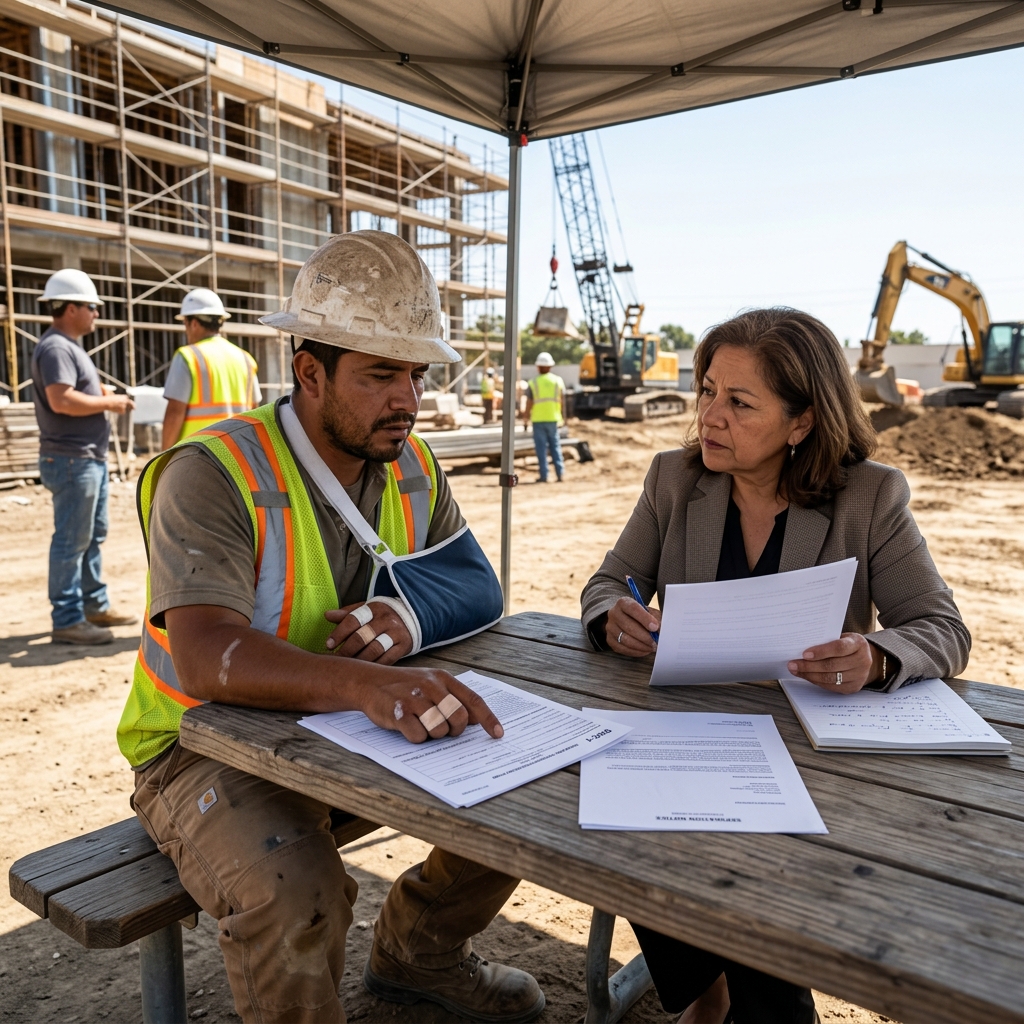
Comparative evidence strengthens retaliation claims. If your company accommodated other injured workers, failed to terminate them for comparable performance issues, or treated uninjured employees more favorably, those comparisons prove selective treatment based on your claim status.
We also examine the employer’s stated business reasons. If the company claimed budget cuts necessitated your termination, we examine whether other workers were also terminated. If only injured workers were let go during alleged budget constraints, that selective termination suggests retaliation.
Actionable takeaway: Request written explanation of the termination reason from your employer if you haven’t received one. Written responses often contain admissions or contradictions useful in litigation.
Common Wrongful Termination Scenarios in Construction
Our experience represents construction workers across multiple wrongful termination scenarios. Understanding common patterns helps you recognize whether your situation reflects illegal treatment.
The immediate injury termination occurs when workers suffer on-site injuries and face termination within days or weeks. A carpenter injures his back during a fall, seeks medical treatment, files a workers’ compensation claim, and then is told his position was eliminated. Investigation reveals no legitimate business reason for the sudden termination.
The disability accommodation scenario involves workers requesting modifications after injuries prevent them from performing original job duties. An employer denies reasonable accommodations and terminates instead of engaging in the interactive process FEHA requires. A laborer with knee injuries requests permission to work desk jobs temporarily; the company refuses and fires him.
The safety report termination happens when workers report unsafe conditions or OSHA violations and face retaliation. Workers who report unprotected heights, inadequate fall protection, or hazardous chemical exposure sometimes face termination disguised as performance issues.
The cumulative trauma claim scenario applies to workers with occupational injuries developed over time. Concrete workers developing carpal tunnel syndrome from repetitive vibration tool use often discover they’re terminated once they file cumulative trauma claims. The employer suggests the worker can’t perform duties due to the worker’s own condition.
The psychological claim termination targets workers with PTSD, anxiety disorders, or depression resulting from workplace incidents. Construction workers traumatized by serious site accidents or witnessing coworker injuries sometimes face termination when they seek mental health treatment or request modified duties.
Understanding your situation against these patterns helps identify potential legal claims.
Actionable takeaway: Consider whether your termination followed a recognized pattern. Pattern evidence strengthens our legal arguments.
Your Free Consultation: How We Evaluate Your Case
We provide free initial consultations to all injured construction workers considering wrongful termination claims. During this consultation, we evaluate whether you have a viable case, explain applicable law, and discuss our representation approach.
We begin by listening to your complete story. We need the full timeline: when your injury occurred, how you reported it, what communications followed, and the events leading to termination. We take detailed notes and ask clarifying questions. Nothing said during this consultation is privileged yet, so be completely honest about any complications or weaknesses in your situation.
Next, we examine what documents you have. Bring any employment agreements, handbooks, performance reviews, termination letters, text messages, emails, or other communications. We also ask about your job responsibilities, your performance history, and how your employer treated other injured workers.
We explain California’s wrongful termination laws as they apply to your facts. We discuss which legal theories might support your claim, potential obstacles, and realistic damage estimates. We’re honest about both strengths and weaknesses.
We also discuss your workers’ compensation claim status. Often, wrongful termination claims complement workers’ compensation cases. Your workers’ compensation attorney should coordinate with us to ensure both claims proceed strategically.
Finally, we discuss next steps. If your case appears viable, we explain our contingency fee arrangement. You pay nothing unless we recover damages for you. Our fee comes from your settlement or judgment. If we decline representation, we explain why and suggest alternative resources.
Actionable takeaway: Prepare a written timeline before your consultation. Dated details help us evaluate your case thoroughly.
Why Timing Matters in Construction Termination Claims
Timing affects both the strength of your claim and your available remedies. Several time constraints govern wrongful termination litigation.
Statute of limitations for wrongful termination claims is typically three years from the termination date. However, don’t wait this long. Evidence degrades over time. Witnesses move away or forget details. Construction sites change. The sooner we investigate, the better our evidence gathering.
The temporal proximity between your protected activity and termination influences case strength. If you filed a workers’ compensation claim on Monday and were fired Friday, that proximity strongly suggests causation. A termination occurring months after your claim is harder to connect causally, though not impossible.
Workers’ compensation claims have separate timing requirements. You must report your injury within a specific timeframe, and you must file workers’ compensation claims within applicable periods. These deadlines sometimes conflict with wrongful termination timing strategies.

Statute of repose issues also arise. Some positions are project-based, ending on predetermined dates. Timing your termination against project end dates matters. If your employer terminated you weeks before a project actually ended, timing suggests retaliation rather than legitimate project completion.
Administrative exhaustion may apply depending on your claim category. Some FEHA claims require administrative review before litigation. We navigate these procedural requirements to protect your legal rights.
Actionable takeaway: Contact us immediately after termination rather than waiting. Early action preserves evidence and ensures compliance with all applicable deadlines.
Our Track Record Representing Construction Workers
We’ve represented construction workers throughout California in countless wrongful termination cases. Our experience spans all construction trades: ironworkers, carpenters, electricians, plumbers, laborers, and specialized trades.
Our cases have recovered substantial settlements and judgments. We’ve secured six-figure settlements for workers terminated after workplace injuries. We’ve obtained awards covering lost wages, emotional distress damages, and punitive damages. Our clients receive compensation reflecting the true harm they suffered.
Beyond monetary recovery, we’ve helped clients vindicate their rights and restore their professional reputations. Construction is a tight-knit industry. Wrongful termination sometimes affects your ability to find future work. Through litigation or negotiated resolution, we demonstrate that you were treated illegally, not fired for legitimate business reasons.
Our approach combines aggressive advocacy with practical settlement negotiation. Many construction company insurers prefer resolving cases rather than facing trial. We leverage our litigation strength to obtain favorable settlements when clients prefer certainty over trial risk. We also try cases when companies refuse reasonable settlements.
Construction clients appreciate our understanding of industry practices, site operations, and trade-specific dynamics. We don’t approach your case with generic employment law experience. We understand construction business models, project timelines, and industry employment patterns. That specialized knowledge improves our case evaluation and advocacy.
Actionable takeaway: Ask potential attorneys about their construction industry experience. Construction-specific knowledge improves representation quality.
Take Action Now: Protecting Your Legal Rights
If you believe your construction job ended because of a workplace injury claim, safety report, or protected action, contact us immediately. You have legal rights protecting you from retaliation, and we can help you enforce those rights.
The first step is your free consultation. Call us or request a consultation through our website. We’ll review your situation at no cost and no obligation. If your case appears viable, we’ll explain how we represent you and what you might recover.
Don’t delay. Evidence deteriorates with time. Witnesses become unavailable. Your memory of conversations and events fades. Early action strengthens your case considerably.
We also recommend coordinating with your workers’ compensation attorney if you have one. Wrongful termination and workers’ compensation claims often proceed together, requiring strategic coordination. We’ll communicate with your workers’ compensation counsel to ensure your claims proceed efficiently.
If you need guidance on identifying whether your termination was wrongful, we’ve developed resources to help. Our construction wrongful termination strategies guide addresses the most effective approaches for construction workers facing retaliation. We also maintain an employment discrimination checklist that helps you evaluate whether discrimination played a role in your termination.
You shouldn’t navigate this alone. California law provides strong protections for construction workers illegally terminated. We’ve dedicated our practice to enforcing those protections. Reach out to the California Work Injury Law Center today and let us help you protect your rights and recover the compensation you deserve.
Schedule a Free Consultation Phone Number: 657 605 4418
Frequently Asked Questions (FAQ)
What should I do immediately after being terminated from a construction job following a workplace injury?
We recommend documenting everything related to your termination while details are fresh in your memory, including dates, conversations, and any written communications from your employer. Contact our office as soon as possible because California law has strict time limits for filing wrongful termination claims, and we need to preserve evidence quickly. We can evaluate whether your termination was retaliatory and advise you on protecting your workers’ compensation claim simultaneously.
Can I pursue both a workers’ compensation claim and a wrongful termination lawsuit?
Yes, we handle both types of claims in parallel for our clients. Workers’ compensation covers your medical expenses and lost wages, while a wrongful termination claim can recover damages for emotional distress, punitive damages, and other losses that compensation doesn’t cover. We structure your case strategy to maximize your total recovery without these claims conflicting with one another.
How do we prove my employer fired me in retaliation for filing a workers’ compensation claim?
We investigate by gathering your employment records, communications with management, performance evaluations before and after your injury report, witness statements, and any patterns of retaliation in your workplace. We analyze the timing of your termination relative to your injury claim to establish the causal connection California law requires. Our experienced investigators and attorneys know the construction industry’s common retaliation tactics, which gives us an advantage in building a compelling case.