
Table of Contents
- 1. Understanding Multi-Party Liability in Industrial Accidents
- 2. Navigating Third-Party Claims Beyond Workers Compensation
- 3. Building Strong Evidence for Cumulative Trauma Cases
- 4. Securing Maximum Temporary and Permanent Disability Benefits
- 5. Protecting Your Rights in Construction Site Injuries
- 6. Overcoming Insurance Company Defense Tactics
- 7. Leveraging Expert Witnesses for Industrial Negligence Claims
- Frequently Asked Questions (FAQ)
1. Understanding Multi-Party Liability in Industrial Accidents
Most injured workers assume their employer bears all responsibility. In reality, industrial accidents often involve multiple liable parties, and identifying each one dramatically increases your compensation potential.
When a worker is injured at a construction site, for example, the general contractor may bear liability for unsafe conditions, the equipment manufacturer may be responsible for a defective machine, and a subcontractor might have created the hazard. Each party typically carries its own insurance, meaning multiple sources of recovery exist beyond standard workers’ compensation benefits.
We focus on mapping the entire accident chain. This means:
- Identifying everyone present and responsible for safety (contractors, equipment operators, site supervisors, property owners)
- Documenting which party violated specific safety regulations
- Determining whether negligence, breach of warranty, or product defect contributed to the injury
- Calculating exposure for each responsible party’s insurance carriers
The practical benefit is substantial. Workers’ compensation provides predictable but limited benefits. Multi-party claims can recover pain and suffering damages, lost earning capacity, and punitive damages that workers’ comp explicitly excludes. We’ve seen cases where secondary liability claims yielded 3-5 times the workers’ compensation award.
Your action step: If you were injured at a workplace involving equipment, contractors, or third-party vendors, request a detailed incident report and photograph the scene if possible. Document every person present and their role.
2. Navigating Third-Party Claims Beyond Workers Compensation
Understanding your options beyond workers’ compensation is essential. When workplace injuries involve outside parties, you typically have two parallel legal paths: your workers’ compensation claim and separate third-party liability claims.
These work differently. Workers’ compensation is “no-fault,” meaning your employer pays benefits regardless of who caused the accident, but you typically cannot sue your employer. Third-party claims are fault-based, allowing you to pursue negligence damages against parties outside the employment relationship.
We’ve found that many injured workers settle their third-party liability claims too quickly without understanding their full value. Insurance adjusters for third parties move fast, often making early settlement offers that seem reasonable but vastly undervalue the claim.
Key elements of strong third-party claims include:
- Proving the third party owed you a duty of care (nearly universal in workplace settings)
- Demonstrating breach of that duty through specific unsafe acts or conditions
- Establishing causation between the breach and your injury
- Documenting all damages, including medical expenses, lost wages, and permanent limitations
The timing matters significantly. California law allows three years from the injury date to file a third-party lawsuit, but evidence degrades quickly. Witness memories fade, scene conditions change, and documentation gets lost. We recommend filing claims within the first year whenever possible.

Your action step: If a third party was involved in your injury, contact our office within 30 days. Early investigation protects evidence and maximizes claim value.
3. Building Strong Evidence for Cumulative Trauma Cases
Cumulative trauma claims present unique challenges because the injury develops gradually, often without a single “accident moment.” An assembly line worker develops carpal tunnel syndrome over five years. A teacher suffers psychological trauma from ongoing workplace abuse. A construction worker’s back deteriorates from repeated heavy lifting.
These cases require different evidence strategies than acute injuries. Insurance companies frequently deny cumulative trauma claims, arguing the condition is unrelated to work or resulted from normal aging.
Our approach focuses on creating a clear causation timeline:
- Documenting the specific job duties and repetitive elements
- Gathering medical records showing symptom progression
- Establishing that job duties substantially contributed to the injury (not just coincidentally occurred)
- Distinguishing occupational injury from general life wear and tear
- Obtaining medical expert opinions linking the condition to workplace exposure
For psychological trauma cases, we emphasize contemporaneous reporting. Workers who documented workplace incidents, complaints to supervisors, or HR reports as they occurred build much stronger claims than those trying to reconstruct events years later. Medical records from therapists or physicians noting work-related stress similarly strengthen these cases.
California law recognizes cumulative trauma across multiple employers if the substantial contribution occurred during employment. This is valuable for workers whose injuries developed across different jobs in the same industry.
Your action step: If you believe you have a cumulative trauma injury, keep a detailed log of symptoms, job duties, and any workplace incidents for the next 30 days. This documentation becomes crucial evidence.
4. Securing Maximum Temporary and Permanent Disability Benefits
Workers’ compensation disability benefits consist of two categories: temporary disability (while you’re healing) and permanent disability (lasting impairment after maximum medical improvement). Many injured workers leave significant money on the table by not understanding how these benefits are calculated and maximized.
Temporary disability benefits replace approximately two-thirds of your lost wages during recovery. The rate increases regularly, so timing matters. Workers who delay filing or underreport initial work restrictions often receive lower ongoing benefits. We ensure that work restrictions are properly documented and that wage calculations capture all forms of compensation, including bonuses and overtime.
Permanent disability benefits depend on your age, job type, and the severity of remaining limitations. The calculation uses California’s disability rating schedule, and disagreements about your rating frequently arise. Insurance companies often assign lower ratings than justified.
Our strategy for maximizing permanent disability includes:
- Obtaining comprehensive medical documentation of all functional limitations
- Pursuing vocational rehabilitation evaluation to demonstrate reduced work capacity
- Challenging insurer-selected medical evaluators through independent medical examiners
- Documenting job-specific demands that you can no longer perform
- Building your complete benefits picture before settlement
The difference between a 20% permanent disability rating and a 35% rating can exceed $50,000 in lifetime benefits. We fight for every percentage point through medical evidence and comparative analysis.
Your action step: Before accepting any permanent disability settlement, request our free review of the insurance company’s rating. We can often identify undervalued assessments.
5. Protecting Your Rights in Construction Site Injuries
Construction sites present compounded injury risks and legal complexity. Multiple contractors, subcontractors, equipment operators, and property owners create overlapping responsibility. Additionally, construction workers often face misclassification as independent contractors, which limits workers’ compensation eligibility.
We’ve encountered cases where injured construction workers were improperly classified as subcontractors or day laborers, disqualifying them from standard workers’ compensation. This classification issue actually opens the door to more expansive third-party liability claims since the worker isn’t restricted by workers’ compensation exclusivity.
Construction site injuries frequently involve:
- Fall protection failures (inadequate scaffolding, missing guardrails, improper harnesses)
- Electrocution from improper grounding or damaged equipment
- Struck-by accidents from falling materials or equipment
- Caught-in accidents involving trenches, machinery, or collapsing structures
- Heat exhaustion and dehydration in demanding outdoor conditions
For each injury type, specific regulations establish safety standards. When contractors violate these regulations, they create strong negligence evidence. California’s OSHA (Cal/OSHA) reports documenting violations provide powerful documentation.
We also pursue claims against equipment manufacturers when tools or machinery contributed to the injury. A defective nail gun, faulty scaffold connection, or improperly maintained crane can constitute product liability claims separate from contractor negligence.
Your action step: If injured on a construction site, immediately request the project safety inspection records and any Cal/OSHA reports. These documents establish industry standards that applied to your situation.
6. Overcoming Insurance Company Defense Tactics
Insurance companies defending industrial injury claims employ sophisticated strategies designed to minimize payouts. Understanding their common tactics helps us counter them effectively.
One frequent defense strategy involves minimizing causation. Adjusters argue that your injury resulted from pre-existing conditions, personal habits, or non-work factors. They’ll cite a pre-injury sports injury or suggest that normal aging caused your condition. We counter by obtaining detailed medical histories clearly distinguishing pre-existing conditions from your new injury and the aggravation of prior conditions.
Another tactic involves challenging credibility. Insurance investigators photograph injured workers at physical activities, then argue that visible activity contradicts claimed limitations. Workers’ compensation law recognizes that people perform limited activities despite significant injuries, so we educate judges and hearing officers about realistic functional limitations while preventing exaggeration.
Settlement pressure represents a third defense strategy. Early settlement offers may seem reasonable to injured workers unfamiliar with case value. We analyze settlement offers against comparable cases, future medical needs, and your specific earning capacity loss before recommending acceptance or rejection.
Our defensive approach includes:
- Preparing clients for defense medical examinations
- Documenting all medical treatment and functional limitations comprehensively
- Building settlement value analysis using comparable case outcomes
- Challenging improperly qualified defense experts
- Maintaining aggressive timelines that prevent insurance company delay tactics
Insurance companies respect firms that demonstrate willingness to litigate thoroughly. We’ve found that thorough case preparation often results in fair settlements because insurers recognize they face substantial litigation risk.
Your action step: Before any insurance company communication, consult with us. Early coordination prevents statements that undermine your claim.
7. Leveraging Expert Witnesses for Industrial Negligence Claims
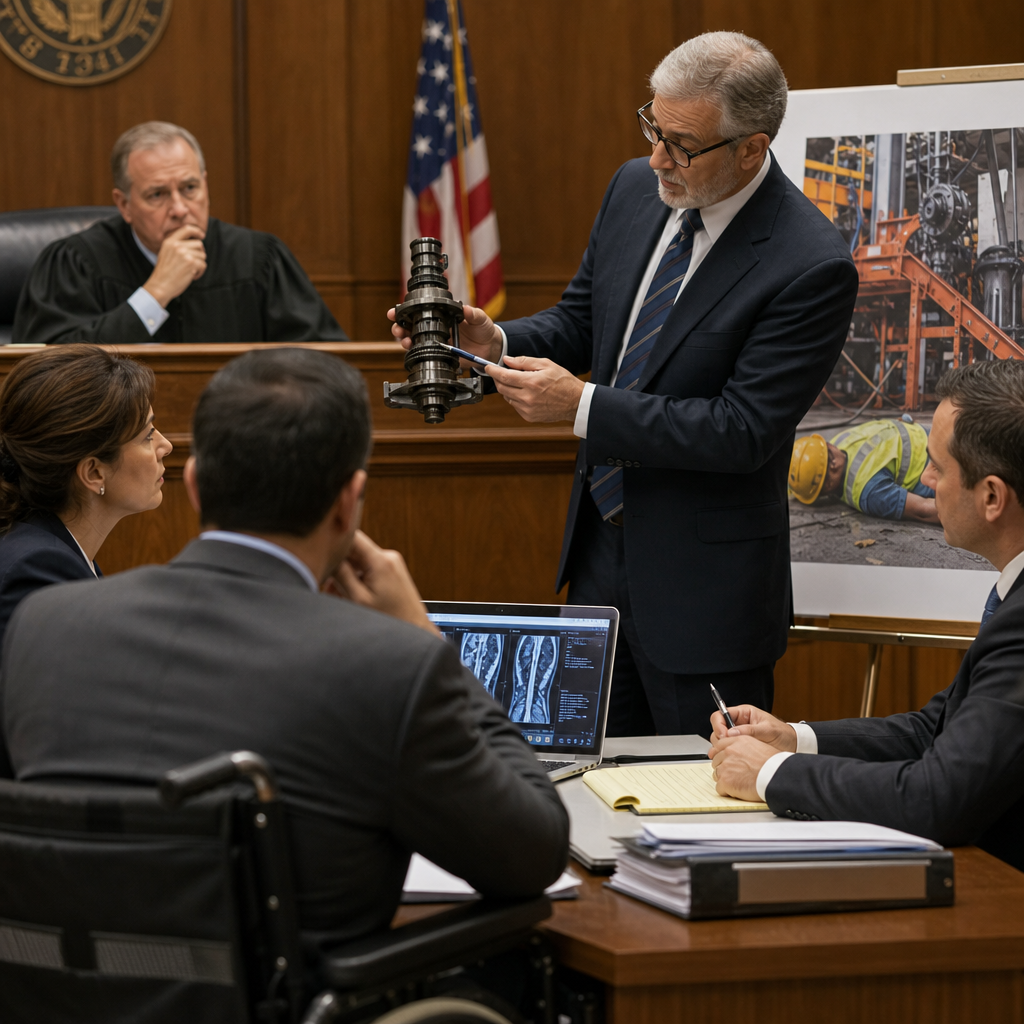
Complex industrial cases live or die on expert testimony. A well-selected expert transforms technical details into compelling evidence that judges and juries understand and credit. Conversely, weak expert testimony loses even strong factual cases.
We work with specialists across multiple disciplines. Safety engineers establish that defendants violated industry standards and that compliant alternatives existed. Occupational medical doctors connect workplace exposures to diagnosed conditions. Vocational rehabilitation experts quantify earning capacity loss. Economists calculate lifetime damage projections.
The key is matching the right expert to your specific case issue. A construction fall injury requires a safety engineer with specific fall protection experience. A toxic exposure case demands an occupational hygienist who can establish exposure levels and health effects. A psychological trauma case benefits from a clinical psychologist experienced with workplace stress injuries.
Expert selection involves vetting credentials, reviewing prior testimony, and assessing communication ability. An expert with impressive academic credentials but poor communication skills undermines your case. We select experts who combine substantive knowledge with the ability to explain complex concepts clearly.
Timing is equally important. Early expert engagement allows collaboration on case strategy. Late expert retention results in hasty analysis and weaker opinions. We engage key experts within 60 to 90 days of case acceptance.
We also prepare clients extensively for defense expert testimony. Knowing what opposing experts will argue allows us to challenge their conclusions and present counter-evidence. This preparation prevents defensive reactions and strengthens your credibility.
Your action step: Provide us with detailed medical records and incident documentation immediately. Early review by our medical consultant identifies expert needs before deadlines pass.
For further reading: Third-party liability.
Schedule a Free Consultation Phone Number: 657 605 4418
Frequently Asked Questions (FAQ)
What makes complex industrial injury cases different from standard workers’ compensation claims?
Complex industrial cases often involve multiple responsible parties, cumulative trauma that developed over time, or significant permanent disabilities that require specialized litigation strategy. We handle these intricate situations by investigating all potential liability sources and pursuing third-party claims that can substantially increase your recovery beyond basic workers’ compensation benefits. Our approach recognizes that industrial accidents rarely have simple causes, and we build comprehensive evidence to hold all responsible parties accountable.
How do we help clients overcome insurance company defense tactics?
Insurance companies use sophisticated strategies to minimize payouts, including disputing injury causation and downplaying disability severity. We counter these tactics by gathering independent medical evidence, documenting your work history thoroughly, and anticipating their arguments before they surface. Our team knows how insurers operate because we’ve litigated against them for years, so we structure your case to withstand their most aggressive defenses.
What should injured workers know about third-party claims in industrial accidents?
Many injured workers don’t realize they can pursue claims against parties outside the workers’ compensation system, such as equipment manufacturers, contractors, or property owners whose negligence contributed to their injury. We evaluate every accident to identify these additional defendants because third-party settlements often exceed what workers’ compensation alone provides. If you’ve been hurt in an industrial setting, we recommend discussing your specific situation with us during a free consultation to determine what claims you may have.