
Table of Contents
- Why Warehouse Forklift Accidents Demand Immediate Legal Action
- Common Injuries From Forklift Accidents in California Warehouses
- How Our Firm Handles Forklift Accident Injury Claims
- Calculating Your Temporary and Permanent Disability Benefits
- Proving Negligence in Warehouse Forklift Accident Cases
- Insurance Company Tactics We Protect You From
- Our No Recovery, No Fee Commitment to You
- Steps to Take Immediately After Your Forklift Injury
- Why You Need Expert Legal Representation for Warehouses
- Your Free Consultation With Our Injury Attorneys
- Frequently Asked Questions (FAQ)
Why Warehouse Forklift Accidents Demand Immediate Legal Action
Forklift accidents in California warehouses cause serious injuries every year, yet many injured workers don’t realize their full legal rights. We at California Work Injury Law Center have represented hundreds of warehouse employees who suffered forklift-related injuries, and we understand how overwhelming the process can be. From the moment impact occurs to negotiating fair compensation, you need someone in your corner who knows California’s workers’ compensation system inside and out.
Forklift accidents happen fast, but the consequences last. A worker struck by a forklift, crushed beneath a fallen load, or pinned against a rack faces immediate hospitalization and months or years of recovery. The financial and medical stakes are enormous.
Here’s why acting quickly matters: California’s workers’ compensation system has strict filing deadlines. You have one year from your injury date to file a claim, but the sooner you report your injury and document everything, the stronger your case becomes. Insurance companies begin their own investigation immediately, and having legal representation from the start levels the playing field.
Beyond the basic claim, you may also have grounds for a third-party lawsuit. If your injury resulted from equipment manufacturer defects, inadequate maintenance, or a contractor’s negligence on a construction or warehouse site, you could recover damages beyond workers’ compensation limits. These opportunities vanish if not pursued within the statute of limitations.
Take action now: Report your injury to your employer in writing and photograph the accident scene if you’re able. Contact a workers’ compensation attorney before the insurance company contacts you.
Common Injuries From Forklift Accidents in California Warehouses
Forklift injuries vary widely depending on how the accident occurs. Understanding what you might be facing helps you anticipate medical needs and claim value.
The most frequent injuries we handle include crush injuries (when a forklift pins a worker against a surface or load), fractures (legs, ribs, spine), and traumatic brain injuries from impact. Spinal cord damage can result in permanent paralysis. Many workers develop lasting chronic pain, nerve damage, and reduced mobility even after surgery.
Some injuries aren’t immediately visible. Internal bleeding, organ damage, and soft tissue injuries like herniated discs may not show symptoms for days or weeks. Workers in warehouse environments also face cumulative trauma claims if repeated forklift incidents or near-misses cause psychological injury or occupational stress disorder.
Back injuries deserve special mention because they’re common, complex, and often underestimated. A worker hit by a forklift or jarred by an accident may not need immediate surgery, but degenerative changes develop over months. We’ve represented clients whose initial “minor” back strain became a career-ending condition requiring multiple surgeries.
Your next step: Have a comprehensive medical evaluation even if your symptoms seem mild. Document all injuries, treatment, and how they affect your ability to work.
How Our Firm Handles Forklift Accident Injury Claims
We handle each case with a structured approach designed to maximize your recovery. From our first consultation, we investigate the accident thoroughly, gathering evidence before memories fade and before the warehouse has incentive to alter safety records.
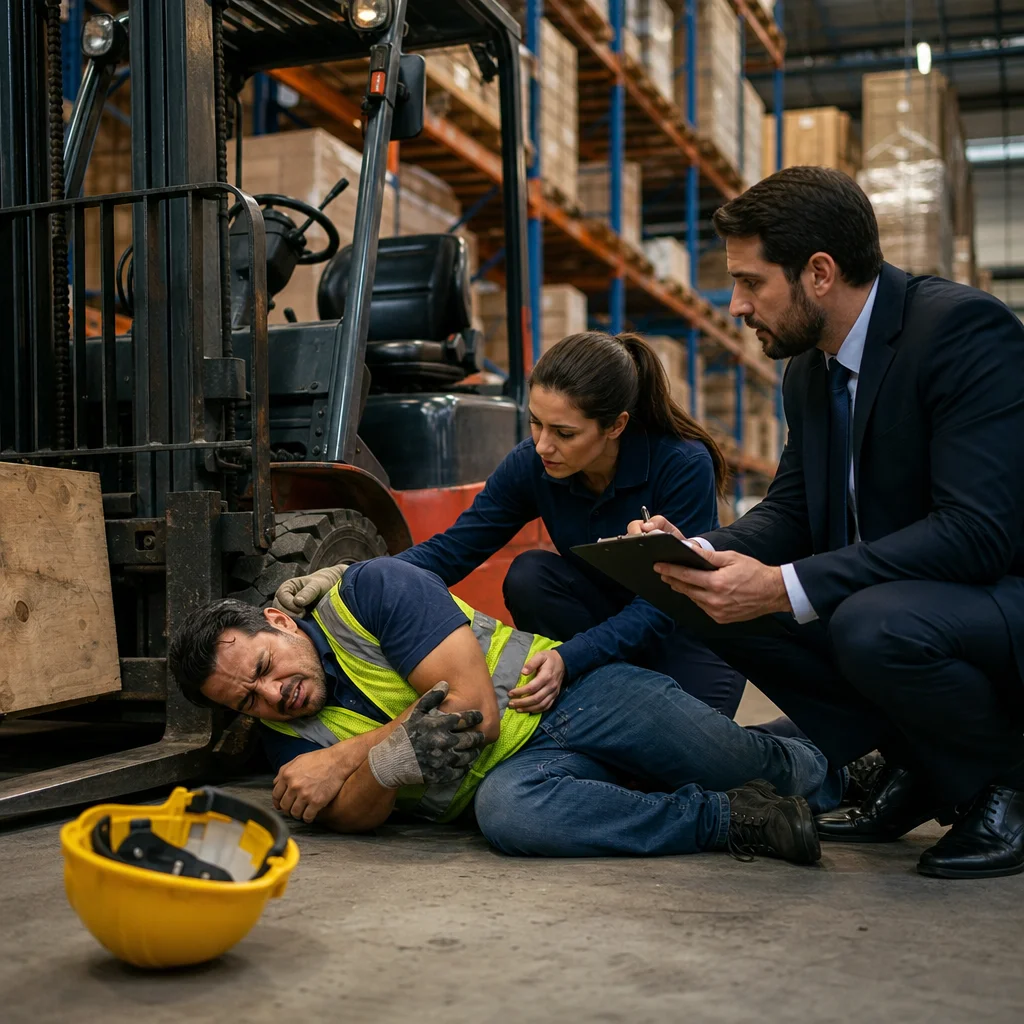
Our investigation includes reviewing employer safety protocols, forklift maintenance logs, training documentation, and witness statements. We often bring in occupational safety experts to establish whether your employer violated Cal/OSHA standards. Those violations strengthen your claim and sometimes indicate negligence that could support additional damages.
We also coordinate closely with your medical team. We understand medical terminology and can translate complex diagnoses into clear arguments for disability benefits. Rather than accepting the insurance company’s initial offer, we obtain independent medical evaluations when necessary and build a compelling narrative about your injury’s lasting impact.
As a warehouse injury lawyer focused on warehouse workers, we know the specific hazards of your environment and how negligent practices create liability.
Calculating Your Temporary and Permanent Disability Benefits
California’s workers’ compensation system provides both temporary disability (TD) benefits while you heal and permanent disability (PD) benefits if your injury causes lasting impairment.
Temporary disability replaces lost wages while you’re unable to work. The rate is typically two-thirds of your average weekly wage, up to a maximum set by California’s Division of Workers’ Compensation. If your injury requires six weeks of treatment, you receive six weeks of TD benefits. If you’re partially able to work, you may qualify for temporary partial disability.
Permanent disability is more complex. The insurance company assigns your injury an impairment rating based on medical evidence and California’s Permanent Disability Rating Schedule. An injured shoulder might receive a 15% rating; a serious back injury could be rated at 40% or higher. Your PD benefit is calculated by multiplying your rating percentage by a statutory award amount adjusted for your age and occupation.
Here’s where many workers lose money: insurance companies sometimes underrate injuries or ignore important medical findings. We contest inadequate ratings by presenting additional medical evidence, life impact testimony, and vocational rehabilitation reports showing reduced earning capacity.
Action item: Request a copy of your permanent disability rating decision. If the rating seems low relative to your medical condition and job loss, we can challenge it.
Proving Negligence in Warehouse Forklift Accident Cases
Some forklift injuries are true accidents, but many result from negligence that you can hold someone liable for. California law requires proving four elements: duty, breach, causation, and damages.
The warehouse employer has a duty to maintain safe working conditions, provide proper equipment, and ensure adequate training. They breach that duty when they fail to inspect forklifts regularly, allow untrained operators, ignore Cal/OSHA violations, or maintain crowded conditions. If the breach directly caused your injury and you suffered damages, you have a valid negligence claim.
Documentation is crucial. We obtain OSHA incident reports, safety inspection records, maintenance logs, and training certificates. We interview coworkers about prior unsafe incidents. We review warehouse floor plans to show overcrowding or visibility problems. We examine the specific forklift model for known defects.
Third-party liability is particularly valuable. If a forklift manufacturer knew their model had visibility problems or stability issues, they can be sued directly for product liability. Equipment rental companies bear responsibility if they rent unsafe forklifts. Construction contractors can be liable for inadequate site supervision.
Insurance Company Tactics We Protect You From
Insurance adjusters work to minimize what they pay, and they use several familiar strategies. Understanding these tactics helps you avoid costly mistakes.
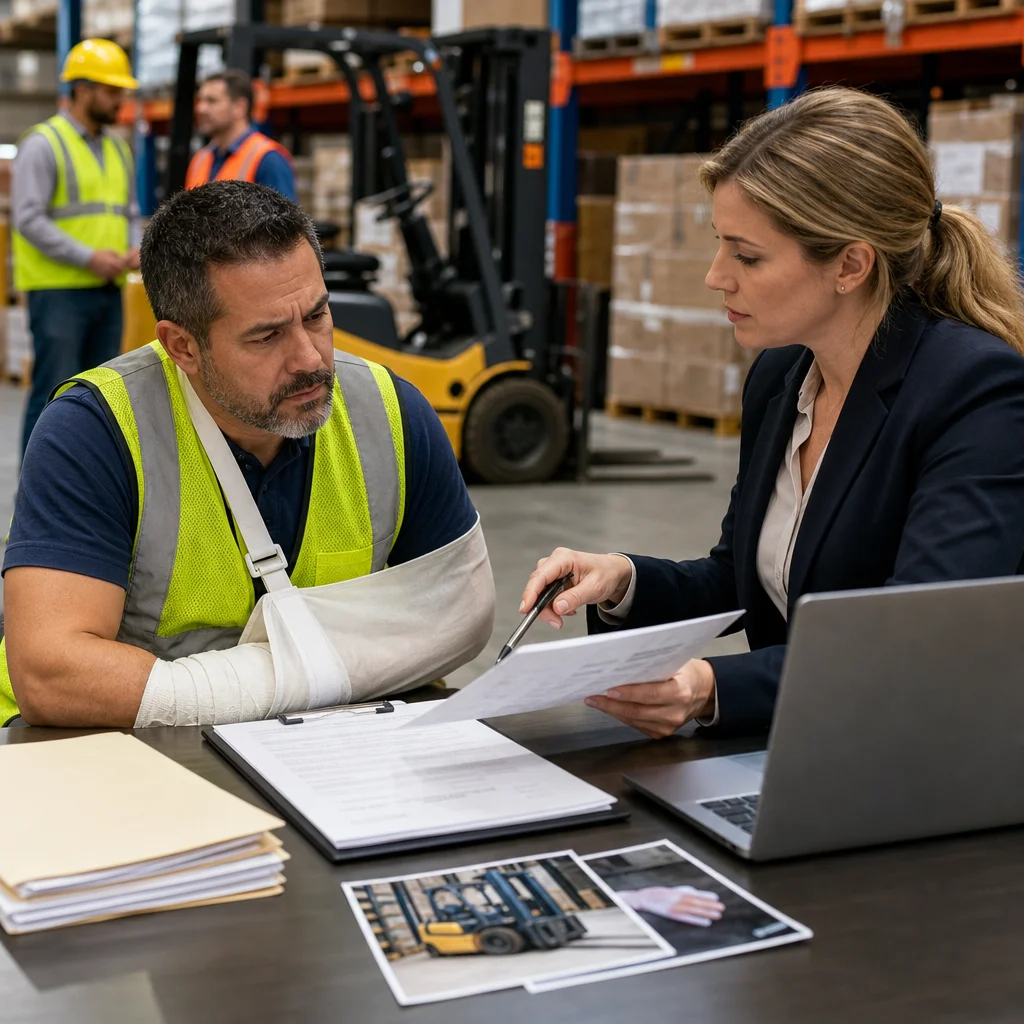
One common approach is offering a quick settlement before you understand your injury’s full extent. A seemingly generous offer for a few thousand dollars might ignore permanent effects requiring decades of treatment. We refuse settlements until medical recovery is stable or permanent, ensuring you’re compensated fairly for actual damages.
Insurers also dispute causation by suggesting your injury resulted from a pre-existing condition, not the forklift accident. They’ll request medical records from years ago, looking for any spine issue or prior injury to blame. We counter this by showing how the accident materially worsened your condition or proving that the prior condition was resolved.
Insurers minimize your credibility through surveillance, requesting vocational evaluations, or having their own doctors examine you. They hope you’ll contradict yourself or they’ll find evidence you’re more capable than you claim. We prepare you for these encounters and ensure medical records support your actual functional limitations.
Our No Recovery, No Fee Commitment to You
We represent injured California workers under a no recovery, no fee contingency model. You pay nothing upfront, nothing during your case, and nothing if we don’t recover compensation for you. Our fee comes only from a percentage of what we win.
This arrangement aligns our interests with yours. We don’t succeed unless you do. We won’t recommend settling for inadequate amounts because our compensation depends on maximizing your recovery. We also won’t take on cases we don’t believe in, so if we take your case, we’re confident we can help.
This model removes financial barriers to getting legal help. You’re never choosing between hiring an attorney and paying medical bills. We handle all costs of investigation, expert witnesses, and court fees.
What this means for you: Schedule your free consultation without worrying about cost. We’ll assess your claim honestly and tell you what recovery is realistic.
Steps to Take Immediately After Your Forklift Injury
The first hours and days after your accident set the foundation for your entire claim. Taking the right steps now protects your legal rights and strengthens your case.
Report your injury to your supervisor and request a written injury report form immediately. Don’t downplay your symptoms or say “I’m fine” to avoid inconveniencing the company. Your words can be used against you later.
Seek medical treatment right away, even if you feel okay. Some injuries manifest hours or days later. Get a medical record documenting your symptoms, mechanism of injury, and the forklift accident’s details.
Photograph the accident scene if possible: the forklift, the surrounding area, visibility lines, proximity to other workers. Take photos of your injuries. Preserve your work clothes if they bear impact marks.
Write down everything you remember while it’s fresh: time of day, weather, what you were doing, who was present, what the forklift operator was doing, and how the accident occurred. Get contact information from witnesses before they leave.
Don’t sign anything beyond your initial injury report without legal review. Insurance companies will present documents for you to sign; some contain language minimizing their liability or your injuries.
Why You Need Expert Legal Representation for Warehouses

Warehouse injuries are specialized. Standard workers’ compensation attorneys may not understand forklift dynamics, warehouse safety standards, or industry-specific hazards. We’ve built our practice representing warehouse workers, and we know what insurers expect in these cases.
Our experience means we recognize retaliation attempts quickly. Some employers retaliate against workers who file claims by cutting hours, reassigning them to worse positions, or firing them. California law prohibits this retaliation, and we’ll hold employers accountable.
We also navigate the complexity of third-party claims. A forklift accident might involve your employer’s negligence, the equipment manufacturer’s defect, a contractor’s failure to maintain safe conditions, or the rental company’s failure to maintain equipment. Each party creates separate liability and potential recovery sources. Our team identifies all responsible parties and pursues compensation from each.
Finally, our forklift accident guide provides detailed information about your rights, but nothing replaces personalized legal advice for your specific situation.
Your Free Consultation With Our Injury Attorneys
You don’t need to navigate this alone. We offer free legal consultations to injured California workers throughout our state. During your consultation, we’ll discuss your accident, review your injuries, explain your legal options, and honestly assess your case value.
We’ll answer questions about the workers’ compensation process, temporary and permanent disability benefits, and whether third-party liability exists in your situation. We’ll explain our representation, our fee structure, and what to expect moving forward.
Contact California Work Injury Law Center today to schedule your free consultation. We have multiple office locations across California and handle cases statewide. Our team stands ready to fight for the compensation you deserve after your forklift accident injury.
Schedule a Free Consultation Phone Number: 657 605 4418
Frequently Asked Questions (FAQ)
What should I do immediately after a forklift accident at my warehouse job?
First, seek medical attention right away, even if your injuries seem minor, because some symptoms appear later. Then report the accident to your supervisor and employer in writing, take photos of the scene and your injuries, and gather contact information from any witnesses. We recommend contacting us promptly so we can guide you through the claims process and protect your rights before the insurance company contacts you.
How much compensation can I receive for a forklift accident injury in California?
Your compensation depends on several factors including the severity of your injury, whether you have temporary or permanent disability, your average weekly wage, and whether negligence can be proven. We calculate your benefits based on California’s workers’ compensation schedules and help you pursue additional damages if third-party liability exists. During our free consultation, we’ll review your specific situation and provide an honest assessment of what we can recover for you.
Why do I need a lawyer if I already filed a workers’ compensation claim?
Insurance companies use tactics designed to minimize their payouts, including undervaluing permanent disabilities and denying legitimate claims. We handle the complex legal work of gathering medical evidence, proving negligence, and negotiating with insurers on your behalf. Since we work on a no recovery, no fee basis, we only get paid when we win your case, so our interests align directly with yours.