
Table of Contents
- Understanding the Repetitive Stress Injury Challenge
- Key Evidence Criteria for Strong RSI Cases
- Medical Records and Diagnostic Testing Documentation
- Workplace Exposure and Job Duty Analysis
- Expert Medical Testimony and Causation Reports
- Timeline and Progression Documentation Methods
- How We Build Unbeatable RSI Evidence Packages
- Comparing Evidence Strength Across Different Documentation Approaches
- Why California Work Injury Law Center Leads RSI Representation
- Your Path to Maximum Compensation for Repetitive Stress Claims
- Frequently Asked Questions (FAQ)
Understanding the Repetitive Stress Injury Challenge
Repetitive stress injuries (RSI) represent one of the most difficult workers’ compensation claims to prove in California. Unlike a single traumatic event that leaves obvious injuries, cumulative trauma develops gradually through repeated motions, force, or sustained awkward postures. Employers and their insurers scrutinize these claims aggressively because the injury timeline is ambiguous and causation can seem unclear.
The core challenge lies in connecting day-to-day job duties to permanent disability. An injured warehouse worker or assembly line employee must demonstrate not just that they performed repetitive tasks, but that those specific tasks directly caused measurable tissue damage and functional loss. Without compelling documentation, claims get denied or settlements fall far short of what workers deserve.
We’ve handled hundreds of RSI cases across California’s diverse industries, and we’ve learned that successful claims rely on one critical factor: systematic evidence collection from the moment symptoms first appear. The difference between a denied claim and a six-figure settlement often comes down to documentation quality.
Key Evidence Criteria for Strong RSI Cases
California workers’ compensation law requires three foundational elements for any RSI claim:
Causation Evidence: You must show the job duties directly caused the injury, not general lifestyle factors. This means documenting the specific motions, frequencies, and force levels involved in your work.
Medical Diagnosis: An independent medical examination (IME) or treating physician must confirm an objective physical condition like carpal tunnel syndrome, rotator cuff tendinitis, or cervical radiculopathy. Vague complaints of “pain” alone won’t prevail.
Disability Impact: The injury must limit your ability to perform your job or other work. Medical records must clearly describe functional limitations and restrictions.
The strength of your case hinges on how thoroughly you’ve documented each element. A worker who meticulously tracked symptom onset, job duties, and medical visits builds a narrative that’s nearly impossible for insurers to dismiss. Conversely, a worker who sought treatment sporadically and kept no records of work duties faces an uphill battle.
Medical Records and Diagnostic Testing Documentation
Medical documentation forms the backbone of your RSI claim. We always advise clients to ensure their treating physicians understand their job duties in detail, because physicians who understand the work context provide far more compelling medical opinions.
What to document with your healthcare provider:
- Detailed history of how symptoms started and progressed (include specific dates and activities)
- Frequency and intensity of symptom flare-ups tied to work tasks
- Specific job duties that aggravate symptoms
- Any modifications you’ve made to compensate for pain
- All treatments attempted and their outcomes
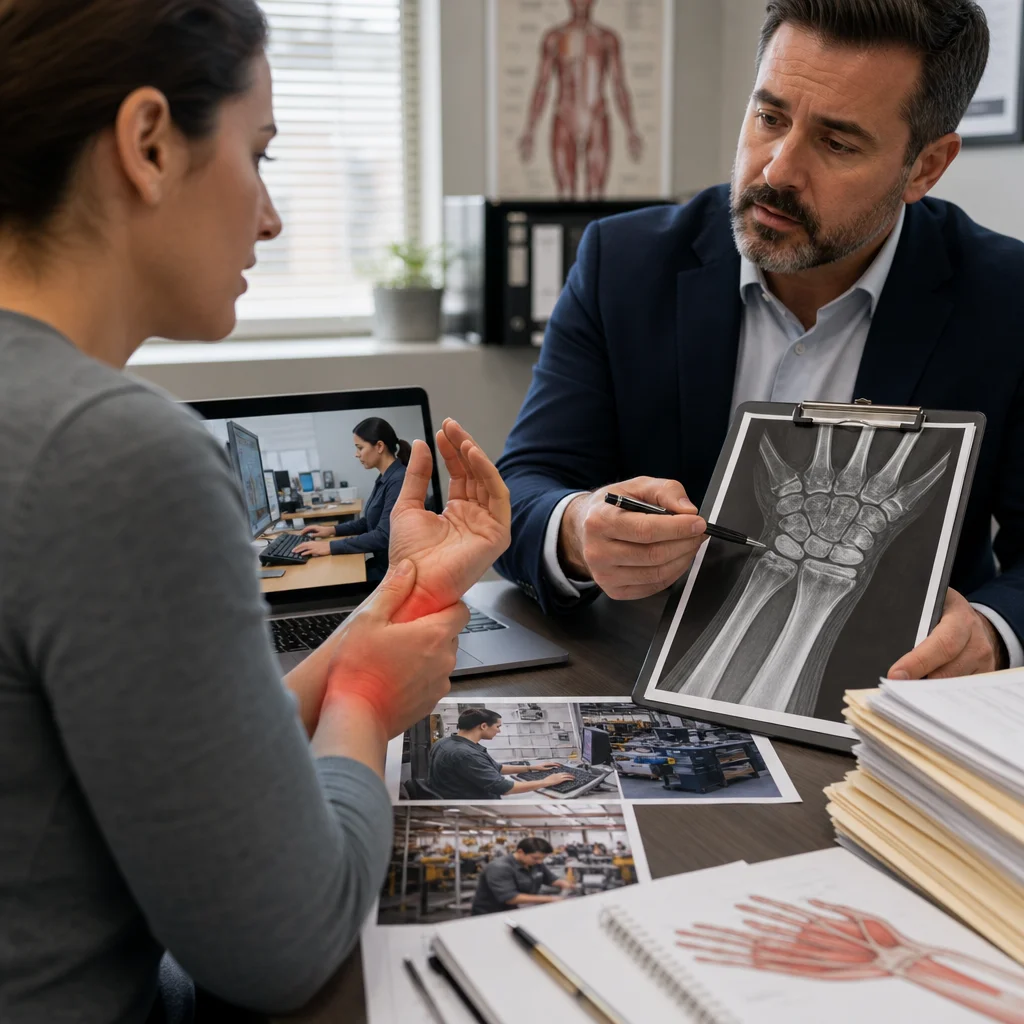
Diagnostic imaging and testing adds objective support to your claim. MRI scans showing rotator cuff tears, EMG/NCV studies confirming nerve compression in carpal tunnel cases, and X-rays documenting cervical or lumbar changes all strengthen your position. Request copies of all imaging and test results immediately after procedures.

Create a dedicated medical file where you maintain every report, test result, and provider note. When your case reaches settlement or trial, you’ll present these records chronologically to show how your condition developed and worsened over time. Gaps in medical documentation create openings for insurers to argue your injury isn’t work-related or isn’t as severe as claimed.
Workplace Exposure and Job Duty Analysis
We conduct detailed job duty analyses that precisely quantify the repetitive exposure that caused your injury. This analysis becomes the critical link between your work and your medical condition.
Your documentation should capture:
- The specific motions you performed (gripping, reaching, typing, bending)
- Frequency per shift or per day (example: 500 grip cycles per hour)
- Force requirements (light, moderate, heavy)
- Duration of uninterrupted repetition
- Postural demands (seated vs. standing, arm position, neck flexion)
- Pace control (whether you controlled the speed or the job dictated it)
Many workers underestimate the value of detailed job descriptions. We’ve seen cases dramatically strengthen when clients documented their actual job duties compared to their official job title. A “data entry specialist” job title tells little; documenting 2,000 keystrokes per hour with wrist deviation at 30 degrees tells everything.
Photograph or video your workstation and the tools you use daily. If your employer won’t allow this, request copies of official job descriptions and ergonomic assessments from your employer or OSHA records. Your workers’ compensation insurer must provide these upon request.
Expert Medical Testimony and Causation Reports
The most powerful RSI claims include expert medical testimony that definitively links workplace exposure to the injury. This isn’t your treating physician’s general opinion, but rather a comprehensive causation report from a specialist in occupational medicine or the relevant medical field.
An occupational medicine expert reviews your medical records, imaging studies, job duty analysis, and work history to render a professional opinion on causation. They address the specific question: “Would this injury have occurred absent the repetitive work exposure?” A strong causation opinion directly connects your job’s biomechanical demands to the tissue damage shown on imaging.
We work with California’s leading occupational medicine physicians who understand both medical science and workers’ compensation law. Their reports explain complex concepts like cumulative microtrauma and latency periods in language that judges and juries understand. When your occupational medicine expert testifies that your rotator cuff tear resulted from overhead reaching 100+ times daily, the evidence becomes nearly conclusive.
Getting this expert involved early strengthens all subsequent claim development. They guide what medical testing you should obtain and help ensure your treating physicians document causation-related facts.
Timeline and Progression Documentation Methods
A clear timeline showing when symptoms began, when you first reported them, and how they’ve worsened over time creates a powerful narrative that matches medical science with your lived experience.
Start documenting immediately when you first notice symptoms:
- Keep a symptom journal noting date, specific activities that triggered symptoms, intensity (1-10 scale), and any functional impact
- Record when you first reported symptoms to your supervisor or safety department
- Document any workplace accommodations you requested or implemented
- Note dates when symptoms prevented you from performing specific job duties
- Track all medical appointments, test results, and treatment dates
This timeline, combined with medical records and job duty analysis, shows the injury developed progressively through work exposure. Insurers can’t credibly argue the injury is unrelated to work when you’ve documented symptom onset coinciding with specific job assignments and progression tracked against medical test results.

We’ve won cases where a worker’s contemporaneous journal entries documented symptom progression week by week, and MRI results months later confirmed the exact tissue damage predicted by that progression. This consistency is powerful evidence.
How We Build Unbeatable RSI Evidence Packages
Our approach to RSI claims combines medical expertise, occupational analysis, and legal strategy into comprehensive evidence packages that leave no room for insurer arguments.
We begin with a detailed intake focused on your complete work history and symptom progression. Our investigators then conduct thorough workplace exposure assessments, sometimes including ergonomic specialists who measure actual job demands and create biomechanical analyses.
We simultaneously guide your medical care, ensuring treating physicians document causation-relevant facts and obtain appropriate diagnostic imaging. We engage occupational medicine experts early to identify what testing will be most probative and to review reports before they’re finalized.
Finally, we organize all evidence chronologically and thematically, creating clear narratives: the symptom progression timeline, the job duty exposure analysis, the medical diagnosis and imaging, and the expert causation opinion. This organized presentation makes your case easy for decision-makers to understand and accept.
The result is an evidence package so compelling that most cases settle favorably before trial. When cases do proceed to hearing, judges and juries make decisions quickly because the evidence is clear.
Comparing Evidence Strength Across Different Documentation Approaches
Not all evidence carries equal weight in workers’ compensation law. Understanding which documentation methods produce the strongest claims helps you prioritize your efforts.
Strongest evidence: Contemporaneous medical records showing symptom onset tied to specific job duties, combined with objective diagnostic imaging, a detailed job duty analysis, and occupational medicine expert causation testimony. This is the gold standard.
Strong evidence: Treating physician records with clear job duty descriptions, diagnostic testing, and a credible timeline, even without formal expert causation testimony. Many cases succeed at this level.
Moderate evidence: Medical records documenting your condition without clear job duty documentation or causation discussion. The medical condition is proven, but the work connection requires inference.
Weak evidence: Delayed medical treatment, vague symptom descriptions, no job duty documentation, and reliance solely on your testimony about job demands. These claims face aggressive resistance.
The practical takeaway: Start documenting immediately, ensure your medical providers understand your job duties completely, and obtain diagnostic imaging that objectively confirms tissue damage. This combination dramatically increases your claim’s strength.
Why California Work Injury Law Center Leads RSI Representation
We’ve built our practice on RSI claims because they demand specialized expertise that general workers’ compensation attorneys often lack. Our team includes attorneys with decades of RSI case experience, strong relationships with leading occupational medicine specialists throughout California, and established protocols for gathering the strongest evidence.
Unlike larger firms that handle RSI claims as one case type among many, we focus deeply on cumulative trauma claims. We understand the nuances of how different occupations create specific injury patterns. We know which imaging studies provide the most compelling evidence for different injury types. We’ve testified in dozens of workers’ compensation hearings where RSI causation was disputed.
Most importantly, we maintain a no-recovery, no-fee model, meaning you pay nothing unless we win your case. This alignment ensures we fight aggressively for maximum compensation because our success directly determines your benefit. We don’t settle for inadequate offers; we’ve built our reputation on securing settlements and awards that genuinely compensate workers for permanent disabilities.
Our office locations throughout California mean you have local representation familiar with your regional industries and the administrative judges hearing your case.
Your Path to Maximum Compensation for Repetitive Stress Claims
Beginning right now, commit to systematic evidence collection. Document your current symptoms daily, noting triggering activities and severity. Request and collect all medical records you’ve ever obtained related to your condition. If you haven’t yet sought medical evaluation, schedule an appointment immediately with a physician who listens carefully to job duty descriptions.
Contact us for a free legal consultation where we’ll evaluate your claim’s strength, identify any evidence gaps, and develop a comprehensive strategy. During that consultation, we’ll explain exactly what documentation we need and what we’ll do differently to prove your case compared to other representation options.
We’ll conduct a detailed occupational analysis of your job, potentially involving ergonomic specialists who quantify the repetitive exposure that caused your injury. We’ll coordinate with occupational medicine experts to ensure your medical care includes appropriate testing and causation documentation. We’ll organize your evidence into a compelling case presentation that makes your injury’s work causation obvious to decision-makers.
Most importantly, we’ll fight to ensure you receive full compensation for temporary disability benefits, permanent disability ratings, medical treatment, and any vocational rehabilitation needs. RSI claims often result in permanent partial disabilities that deserve substantial awards, and our track record shows we consistently achieve better outcomes than workers who navigate these claims alone.
Contact California Work Injury Law Center today. Your free consultation includes a candid assessment of your claim’s value and the specific path forward to maximum compensation. No recovery means no fees, so you have nothing to lose and everything to gain from expert representation focused exclusively on workers’ compensation claims throughout California.
For further reading: Best Medical Evidence for RSI.
Schedule a Free Consultation Phone Number: 657 605 4418
Frequently Asked Questions (FAQ)
What types of evidence do we focus on when building a repetitive stress injury claim?
We prioritize medical documentation, diagnostic testing results, and detailed workplace exposure records that directly link your job duties to your injury. Our approach also includes expert medical testimony that establishes causation and timeline evidence showing how your condition developed over time. Each component works together to create a comprehensive case that demonstrates the connection between your work activities and your repetitive stress injury.
How does our documentation process differ from what injured workers typically gather on their own?
We conduct thorough job duty analysis to identify specific movements and exposures that contributed to your injury, rather than relying on general descriptions. We work with medical experts to ensure testing and examinations focus on the right diagnostic criteria for your particular RSI, and we systematically organize all evidence to address the specific burden of proof required in California workers’ compensation cases. This strategic approach significantly strengthens your claim’s credibility before regulators and insurance carriers.
Why should we represent you in your repetitive stress injury case?
We have extensive experience proving cumulative trauma claims across various industries and occupations throughout California. Our team understands how to challenge insurance company denials of RSI cases and we work on a no recovery, no fee basis, meaning you pay nothing unless we secure compensation for you. We’ll handle the entire evidence-building process so you can focus on your recovery.